
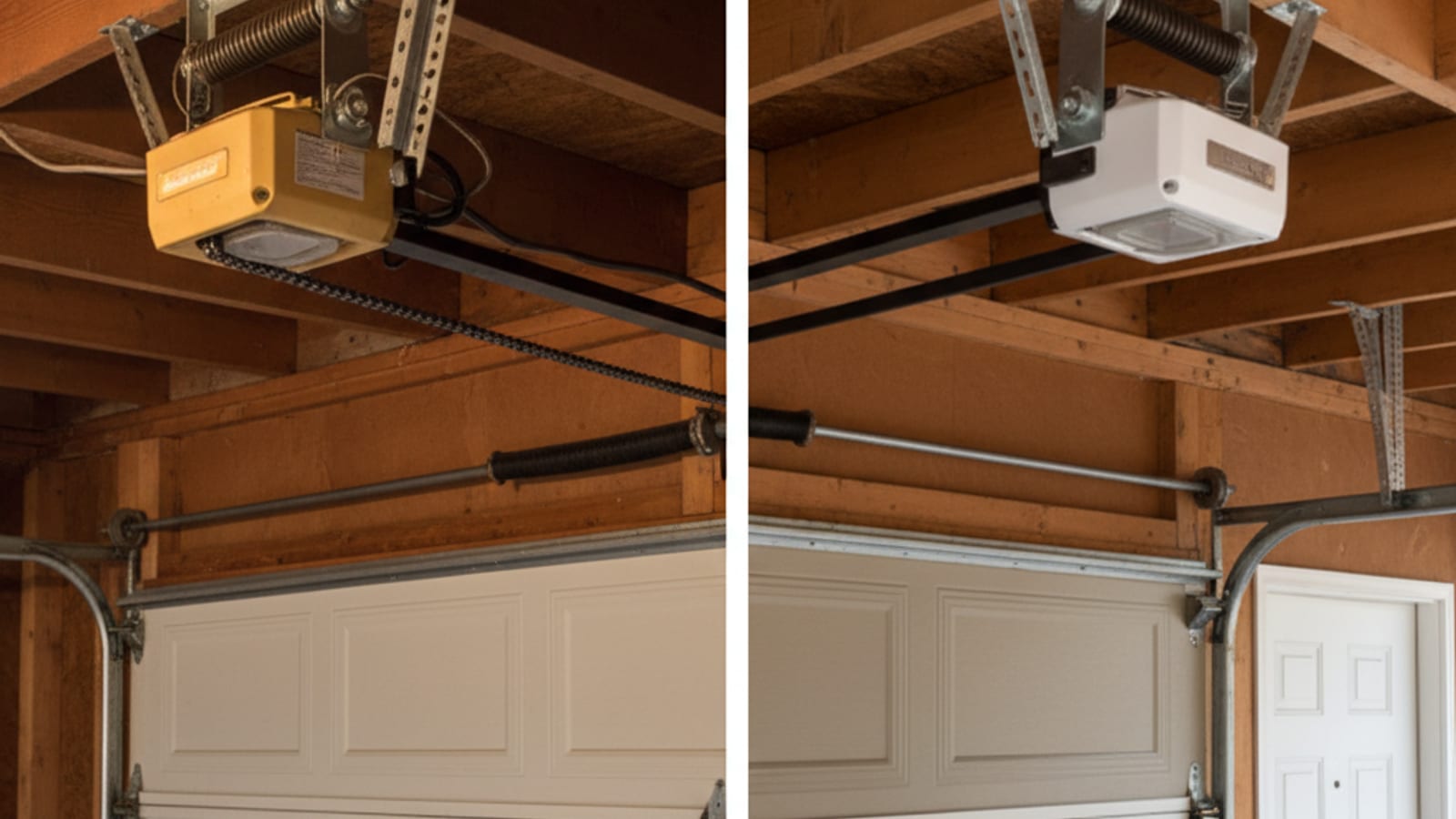
TL;DR
- A garage door opener installation in San Diego costs $350–$1,200 installed in 2026. Most homeowners pay $450–$750 for a quiet belt-drive with Wi-Fi and battery backup.
- Drive type is the biggest variable. Chain-drive runs $350–$600 installed, belt-drive $450–$900, and a wall-mount jackshaft $600–$1,200.
- California’s SB-969 law requires battery backup on every new opener. That’s not an upsell here. It’s the law, and it adds roughly $40–$120 to the unit.
- Labor in San Diego runs $150–$340 for a straight swap. Coastal homes near Coronado, PB, and La Jolla often need rusted hardware replaced at the same time, which adds to the bill.
A garage door opener installation in San Diego costs $350 to $1,200 installed in 2026. Most homeowners land between $450 and $750 for a quiet belt-drive unit with Wi-Fi and a battery backup. The drive type you pick, the lifting power your door needs, and whether old hardware has to come off all move the number. Here’s the full breakdown, with the San Diego specifics the national cost guides skip.
How much does opener installation cost in San Diego?
The total splits into two parts: the opener unit and the labor to install it. Here’s the real 2026 range by drive type, installed.
| Drive type | Unit only | Installed total | Best for |
|---|---|---|---|
| Chain-drive | $150–$250 | $350–$600 | Detached garages, budget swaps |
| Belt-drive | $230–$500 | $450–$900 | Attached garages, bedrooms over garage |
| Screw-drive | $200–$350 | $400–$650 | Mild climates, simpler mechanism |
| Direct-drive | $280–$500 | $500–$850 | Quiet operation, fewer moving parts |
| Jackshaft (wall-mount) | $400–$700 | $600–$1,200 | Low ceilings, high ceilings, ceiling storage |
Labor by itself runs $150 to $340 for a standard swap. A clean replacement takes most crews two to three hours. A first-time install on a door that’s never had an opener, or a switch to a wall-mount jackshaft, can run four to six hours and push labor to the top of that range.
These are installed prices: the opener, the rail, the mounting hardware, programming the remotes and keypad, aligning the safety sensors, and hauling the old unit away. They don’t cover spring or cable work if your door is also out of balance. That’s a separate repair.
The five things that move your price
1. Drive type
This is the single biggest factor. From cheapest to priciest:
- Chain-drive. A metal chain pulls the door. Reliable and cheap, but louder. Fine for a detached garage where noise doesn’t matter.
- Screw-drive. A threaded steel rod does the lifting. Fewer parts, mid-range price. Older models hated temperature swings, but San Diego’s mild climate suits them fine.
- Belt-drive. A reinforced rubber belt replaces the chain. Much quieter. The default pick for attached garages and any home with a bedroom over the garage.
- Direct-drive. The motor itself travels along a fixed chain. Very few moving parts, very quiet, German-engineered in most cases.
- Jackshaft (wall-mount). Mounts on the wall beside the door instead of the ceiling. Frees up overhead space, runs whisper-quiet, and works with low-clearance or cathedral ceilings. The priciest option, but the right call for a lot of San Diego homes with finished garage ceilings or storage racks.
2. Lifting power (horsepower)
Openers are rated by horsepower or its DC equivalent. The heavier the door, the more power it needs.
- 1/2 HP. Handles a standard single or lightweight double steel door. The most common residential size.
- 3/4 HP. For heavier doubles, insulated doors, or carriage-house doors with decorative overlays.
- 1 HP and up. For solid wood, full-view glass, or oversized RV-height doors. Common on the heavier custom doors going into newer San Diego builds.
Underpowering a heavy door is the most common mistake we see. A 1/2 HP motor straining against an insulated 16-foot door burns out years early. Match the power to the door’s weight, not the price tag.
3. California’s SB-969 battery-backup law
This one is non-negotiable in California. Under SB-969, every automatic garage door opener sold or installed in a California home since July 2019 must have a working battery backup. If your opener dies and gets replaced, the replacement has to have it too.
The reason is real. When the power goes out during a wildfire evacuation or a grid event, a backup battery lets you open the door and get the car out. People have died trapped in garages during outages. The battery gives you about 24 hours of operation after the power drops.
Practically, this means battery backup isn’t an optional add-on a salesperson is pushing. It’s baked into every compliant model. It adds roughly $40 to $120 to the unit cost. Any quote you get in San Diego that leaves it off is quoting you an opener that’s illegal to install.
4. Coastal corrosion and old hardware
Here’s what the national cost guides never mention. If you live within a couple miles of the water, salt air has been chewing on your garage hardware for years.
In Coronado, Pacific Beach, La Jolla, Ocean Beach, Imperial Beach, and the Oceanside and Carlsbad coast, we routinely pull openers off doors where the springs, cables, and rollers are rust-stained and seized. The marine layer keeps everything damp most mornings. Salt accelerates it.
You can’t bolt a brand-new opener onto corroded hardware and call it done. A rusted spring or a frayed cable will fail under the new motor’s pull, and you’ll be paying for a second call within months. On coastal jobs we inspect the springs, cables, and rollers before we quote the opener. If they’re going, we tell you up front. Replacing rusted rollers runs $80–$180. A corroded cable set runs $120–$200. Salt-pitted springs are a separate spring replacement job.
Inland homes in Poway, Escondido, Santee, and El Cajon see far less of this. Their hardware usually lasts the full life of the door.
5. First-time install vs. straight swap
Replacing an existing opener is simple. The rail mounting points are already there, the wiring is run, and the door is already set up for power operation.
A first-time install on a door that’s only ever been opened by hand costs more. The crew has to run electrical to the ceiling (often a licensed electrician’s job, $280–$650), mount the rail from scratch, and add the wall button and sensors. Budget the high end of the range, plus the electrical.
Smart Wi-Fi openers: worth it?
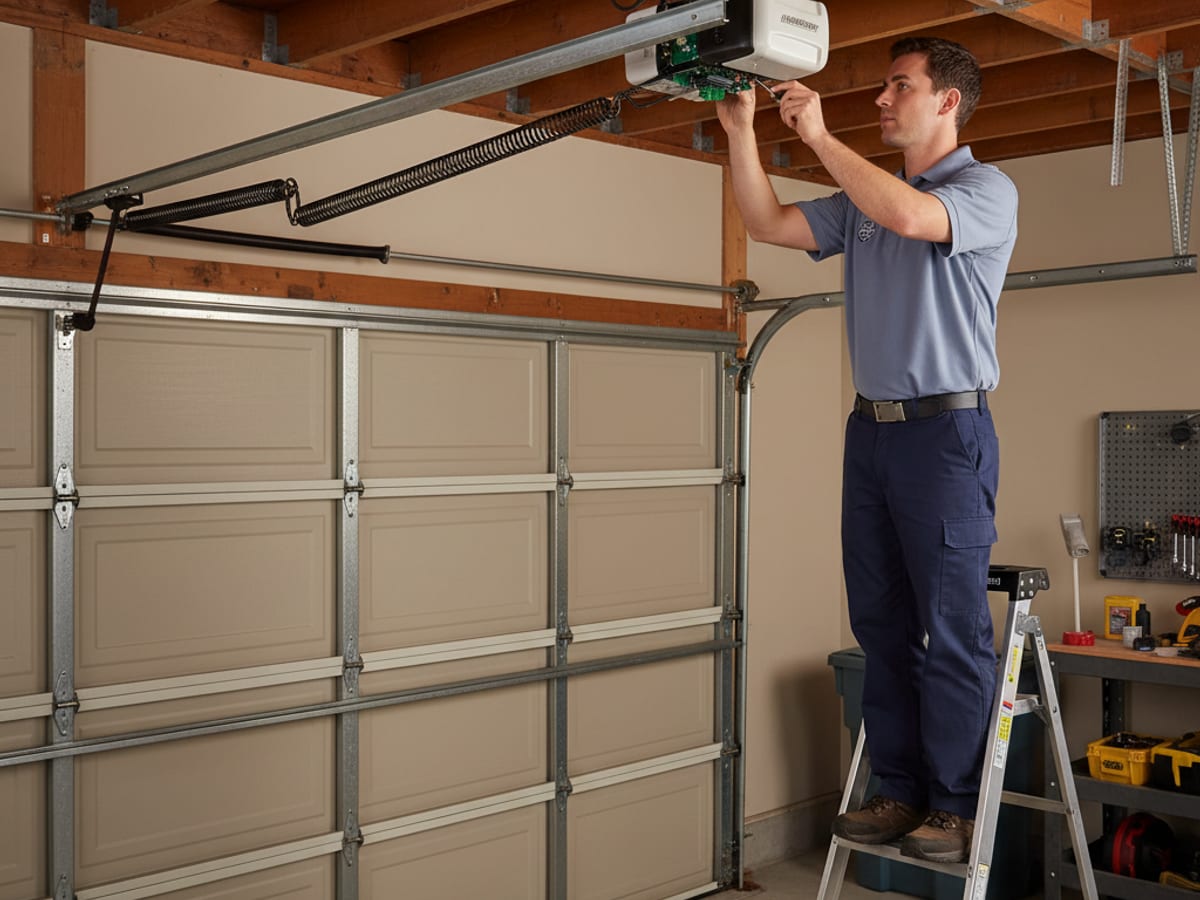
Most new openers ship with Wi-Fi built in now. You open and close the door from your phone, get an alert if it’s left open, and grant one-time access to a delivery driver or house cleaner. Brands like Chamberlain and LiftMaster lead the residential market.
The smart features add maybe $50–$100 over a basic model, and on most 2026 units they’re standard anyway. For the convenience and the security alerts, most San Diego homeowners find it worth it. If you want the full rundown, the Wi-Fi opener guide covers the setup, the apps, and the security tradeoffs.
HOA rules to check first
Openers themselves are inside your garage, so HOAs almost never regulate them. But a few planned communities in San Diego County have rules about exterior keypads, visible wall-mount units near windows, or any change that alters the door’s street appearance.
If you’re in 4S Ranch, Del Sur, Santaluz, Carmel Valley, or a gated Carlsbad or Encinitas development, a 10-minute check of your CC&Rs before install day saves a headache. For a standard ceiling-mount opener swap, you’re almost always clear.
Permits: do you need one?
For a like-for-like opener replacement, no. San Diego County jurisdictions don’t require a permit to swap one opener for another.
A first-time install that needs new electrical wiring to the garage ceiling is different. That electrical work may require a permit, and the electrician usually pulls it. Expect $80–$200 if a permit is needed, typically folded into the electrical quote.
What a fair opener quote includes
A legitimate San Diego opener quote in 2026 should spell out:
- The make, model, and drive type (a Chamberlain B2212T or LiftMaster 8500W, for example)
- The horsepower or DC lifting rating, matched to your door’s weight
- Confirmation it’s SB-969 compliant with battery backup
- Labor, including programming remotes, the wall button, and the exterior keypad
- Safety sensor alignment and a full safe-reverse test
- Haul-away of the old opener
- Any hardware that needs replacing first, line-itemed separately
- The warranty on motor, parts, and labor
Walk away from a quote that gives you one lump-sum number with no model named. You have no way to compare it to a second bid, and you can’t tell if the opener is undersized for your door.
When to repair the opener instead
If your opener is under eight years old and the problem is a snapped drive belt, a worn gear, a dead remote, or a misaligned sensor, repair is far cheaper than replacement. A common opener fix often runs $90–$250.
Replace the opener if any of these are true:
- It’s 12 or more years old (most last 10 to 15 years)
- It has no battery backup and you live in a wildfire or outage-prone area
- It’s loud enough to wake the house and you’ve got a bedroom over the garage
- The logic board is fried and a replacement board costs more than half a new unit
- It predates Wi-Fi and rolling-code security, which is a real break-in risk
Frequently asked questions
How much does garage door opener installation cost in San Diego?
Garage door opener installation in San Diego costs $350 to $1,200 installed in 2026. Most homeowners pay $450 to $750 for a quiet belt-drive unit with Wi-Fi and the SB-969-required battery backup. Chain-drive is cheapest at $350 to $600, and a wall-mount jackshaft is the priciest at $600 to $1,200.
How long does it take to install a garage door opener?
A straight swap of one opener for another takes two to three hours. A first-time install on a door that’s never had a powered opener, or a switch to a wall-mount jackshaft, can take four to six hours, especially if new electrical has to be run to the ceiling.
Do I have to get a battery backup opener in California?
Yes. California’s SB-969 law requires battery backup on every automatic garage door opener sold or installed in a residence since July 2019. A replacement opener must have it too. It adds about $40 to $120 to the unit and gives you roughly 24 hours of operation during a power outage.
Why do coastal San Diego openers cost more to install?
Salt air near the coast corrodes springs, cables, and rollers. In Coronado, Pacific Beach, La Jolla, and the Oceanside coast, that rusted hardware often has to be replaced at the same time as the opener, since a new motor will fail fast pulling against seized parts. That adds $80 to $200 or more to a coastal job.
Can I install a garage door opener myself?
You can, but the safety sensors and the door balance are easy to get wrong, and an unbalanced door will burn out a new opener early. The force and travel limits also have to be set precisely so the door reverses on contact. For a $150 to $340 labor charge, most San Diego homeowners have it done right the first time.
Trying to decide if it’s the opener or the springs? The opener lifespan guide helps you tell. Want the smart-home side before you buy? The Wi-Fi opener guide walks through the apps and security. And if your door won’t close at all, start with the troubleshooting guide before you buy anything.
Want a real opener quote? Call Lift Pro SD at (858) 925-5546 for an upfront price and same-day availability across San Diego County. The techs we send install Chamberlain, LiftMaster, and Genie, and they check your springs and cables first so the new opener lasts. See full opener installation and repair details, from La Jolla to Chula Vista.