
TL;DR
- Check the safety sensors first. A misaligned or blocked photo-eye is the cause of about 70% of “door won’t close” calls. Look for the red LED on one of the two sensors.
- Check the remote and wall button. Dead batteries in a remote or a locked wall button can look like opener failure.
- Disconnect the opener with the red emergency cord and try the door by hand. If it closes smoothly, the opener is the problem. If it binds, the door itself is.
- Don’t force the door closed repeatedly. UL 325 auto-reverse is there for a reason. Forcing past a stuck sensor can pinch a child, a pet, or a hand.
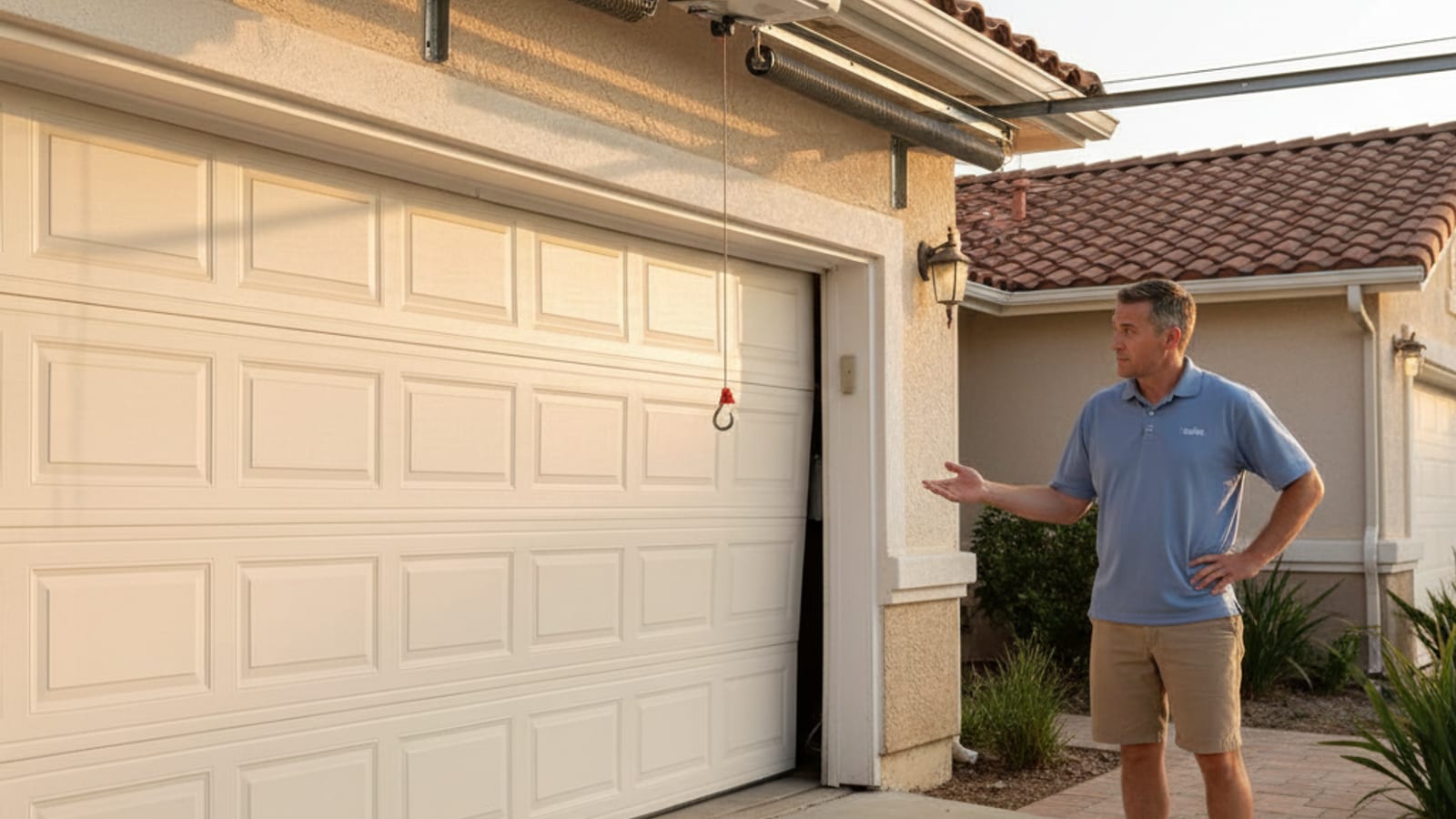
You hit the wall button. The opener motor hums, the door starts down, then jumps right back up like it changed its mind. Or the door won’t move at all, but the opener light blinks ten times. Either way, your car is out, the door is open, and you want it closed before dark.
Before you call anyone, run this 6-step checklist. About 70% of the “won’t close” calls we get are one of the first two items, and homeowners can fix them in 90 seconds once they know where to look.
A few ground rules first. If you see smoke, smell burning wiring, or hear a loud grinding from the opener, stop and call. Those aren’t checklist problems. Everything else, work through this.
1. Look at the safety sensors first
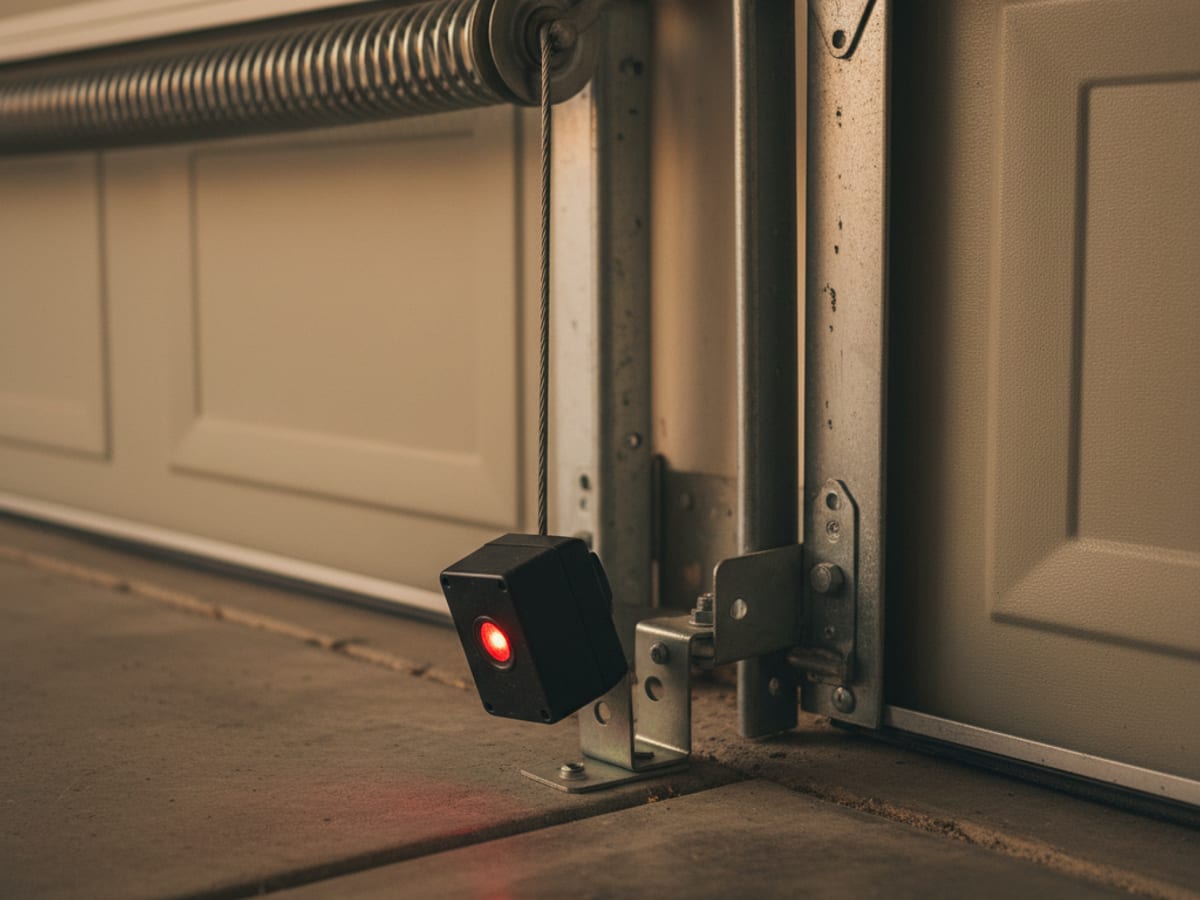
Every garage door made after 1993 has two photo-eye safety sensors mounted six inches off the ground on each side of the door, a federal requirement under UL 325. One sends an invisible beam, the other receives it. If the beam is broken, misaligned, or the lenses are dirty, the opener refuses to close the door. Instead, the opener light blinks (usually 10 times) to tell you: “I tried, something’s in the way.”
Walk to your garage and look at both sensors. One should show a steady green LED. The other should show a steady red LED. That’s the correct look for aligned, working sensors.
Problems to check for:
- Red LED blinking or off entirely. Sensor is misaligned. A bumped bracket, a toy, a yard tool leaning against it, or bracket rust from coastal salt air can all knock alignment off.
- Dirty lens. A spider web, a dust film, or a smudge breaks the beam. Wipe both lenses with a clean dry microfiber cloth.
- Obstruction. Anything across the beam line (trash can, broom, garden hose, a pet) will trigger the sensor. Clear the floor.
- Sun glare. Late afternoon direct sun hitting the receiver can wash out the beam. Check if the issue only happens at the same time of day. A small cardboard sun hood fixes it.
To realign: loosen the wing nut on the sensor bracket, gently rotate the sensor until the red LED goes steady, then tighten. Both sensors should be at the exact same height and aimed directly at each other.
If your sensors need more than alignment, sensor repair is a $120–$190 fix. New sensors cost us about $40 wholesale, so this is the cheapest legitimate repair you can have done.
2. Check the remote, wall button, and lock-out
Second most common cause: the opener isn’t actually getting a close signal.
- Remote battery. CR2032 or A23 12V batteries in most garage remotes. If the remote’s LED is dim or doesn’t light when pressed, swap the battery.
- Wall-mounted keypad battery. If the outdoor keypad doesn’t beep on button press, the 9V battery inside needs changing.
- Wall button “lockout” mode. Most modern wall consoles have a lock button with a padlock icon. If it’s on, the remotes stop working but the wall button still does. Press and hold the lock button for 2 seconds to toggle.
- Vacation mode. Some wall consoles have a “vacation” or “lock” toggle that disables all remotes. Check the manual if you see an LED you don’t recognize.
3. Try the door manually
Pull the red emergency release cord hanging from the opener rail. This disconnects the door from the opener trolley. Now try to open and close the door by hand.
Three outcomes and what they mean:
- Door moves smoothly through full travel. The door and springs are fine. The problem is electrical (opener, sensors, remotes). Back to steps 1 and 2.
- Door is heavy, drops fast, or won’t stay at mid-height. Spring problem. A broken or weakening spring makes the door feel like dead weight. The opener can’t lift it because it’s trying to lift too much. Don’t force it.
- Door binds, catches, or scrapes at a certain point. Track, roller, or cable issue. Look for a cable off the drum, a bent track section, or a roller popped out of the track. This is a garage door repair call.
4. Check the travel limit switch
Modern openers have an “up limit” and “down limit” that tell the opener when to stop. If the down limit gets bumped out of adjustment, the opener can think it’s already at “closed” and refuse to go further, or run the door into the floor hard enough to reverse.
On most LiftMaster, Chamberlain, and Genie openers, the limit adjustment is a pair of screws on the side of the motor housing (look for tiny down-arrow and up-arrow labels). Turn the down-limit screw one quarter turn counterclockwise to let the door travel further down. Test. Repeat one quarter turn at a time until the door closes fully and the opener shuts off.
If the door slams into the floor and reverses, you’ve gone too far, so back off a quarter turn.
Smart openers like the LiftMaster 8500W set limits in the app rather than with screws. Smart-opener setup is covered in our Wi-Fi opener guide.
5. Check the track and rollers
Look at the vertical tracks on either side of the door from top to bottom. Signs of trouble:
- Visible gap between the track and the roller. A cable came off the drum or the roller is worn.
- Bent or kinked track. Someone backed into it, or a car door hit it in the closed position. Bent track catches on close and triggers auto-reverse.
- Loose bolts or brackets. Wiggle the track. It should be firm. Loose mounting bolts cause track to shift under load.
- Missing roller stem. A roller popped out entirely. The door will run out of square and catch.
Most track issues need a tech. Cable and roller replacement or track realignment is a same-day repair.
6. Look at the opener gear, belt, or chain
If the opener motor runs but nothing happens (the trolley doesn’t move), the internal drive gear or belt/chain is toast.
- Gear slipping. Common on chain-drive openers past year 8. The opener hums but the chain doesn’t move the trolley. Plastic main gear stripped. Repair is $180–$320.
- Belt broken. Rare but obvious. Belt hangs limp in the rail. Belt replacement is $140–$220.
- Chain jumped. The chain came off the sprocket on top of the motor. Reseating and retensioning is a 20-minute job.
When to stop troubleshooting and call
Call if you see any of these:
- A broken torsion spring (visible gap in the coil)
- A cable off the drum and hanging slack
- A door that’s off the track and crooked
- Burning smell from the opener motor
- Repeated breaker trips when you try to close
All of the above are emergency-level repairs. Forcing the door through these issues turns a $240 fix into a $650 fix fast.
The one thing not to do
Do not repeatedly press the wall button trying to force the door closed when auto-reverse is triggering. Every cycle of “try to close, bounce back up” wears the limit switch, stresses the springs, and, most critically, trains you to ignore the safety system that’s there to stop the door from closing on a child or pet.
If the door doesn’t close on the first try, check the sensors. If it doesn’t close on the second try, something is wrong. Don’t make it a third.
Frequently asked questions
Why does my garage door close halfway then go back up?
Almost always a safety sensor issue. A misaligned photo-eye, a dirty lens, or sun glare on the receiver will cause the door to reverse partway down. Check both sensors for steady LEDs (one green, one red) before anything else.
Why does the opener light blink 10 times and the door won’t close?
The 10-blink pattern on LiftMaster and Chamberlain openers specifically means “safety sensor beam broken.” Check sensor alignment, lenses, and for obstructions.
Can I bypass the garage door sensors temporarily?
You can hold the wall button down continuously to force the door closed past a sensor fault, which is a code-allowed failsafe. Do this only to close a door with a confirmed-clear path, and only as a one-time move. Don’t unplug or jumper the sensors. It’s illegal for a tech to do and dangerous for a homeowner to do.
Why does my garage door close then pop back open after a second?
Most likely cause: the down-limit switch is set slightly too far, so the door hits the floor with too much pressure and the opener auto-reverses (a UL 325 safety feature). Back the down-limit adjustment off by a quarter turn.
For a full view of the opener-side decision, repair or replace, read the opener lifespan guide. If it turns out to be a spring issue, spring replacement cost has the pricing. And for preventing these calls, the maintenance checklist catches most sensor and track issues before they strand you.
Checklist didn’t solve it? Call Lift Pro SD at (858) 925-5546. Most “won’t close” calls are under $250 and done in under an hour. Same-day across San Diego County, including La Mesa, Santee, Poway, and beyond.