
TL;DR
- Smart Wi-Fi garage door openers cost $480–$950 installed and add app control, status alerts, history logs, voice control (Alexa, Google, HomeKit with add-on), and delivery access features.
- LiftMaster (and sibling brand Chamberlain) dominates the market with myQ, which works on most LiftMaster models made after 2015. Genie’s Aladdin Connect is the strongest alternative. Sommer and Liftmaster Pro Models are premium choices.
- California SB-969 (July 2019) requires battery backup on all new opener installations. Most modern smart openers include it, but check the model number, don’t assume.
- Apple HomeKit support requires an extra bridge device on most openers (the myQ Home Bridge is about $80). Chamberlain’s newest models ship with HomeKit built in.
Your Amazon driver stood at your front door for six minutes yesterday because no one heard the bell. Your kid got home from school and you had no idea. You called, you texted, nothing. Your neighbor watched a couple of guys in a pickup cruise slowly past three driveways looking for unsecured garages.
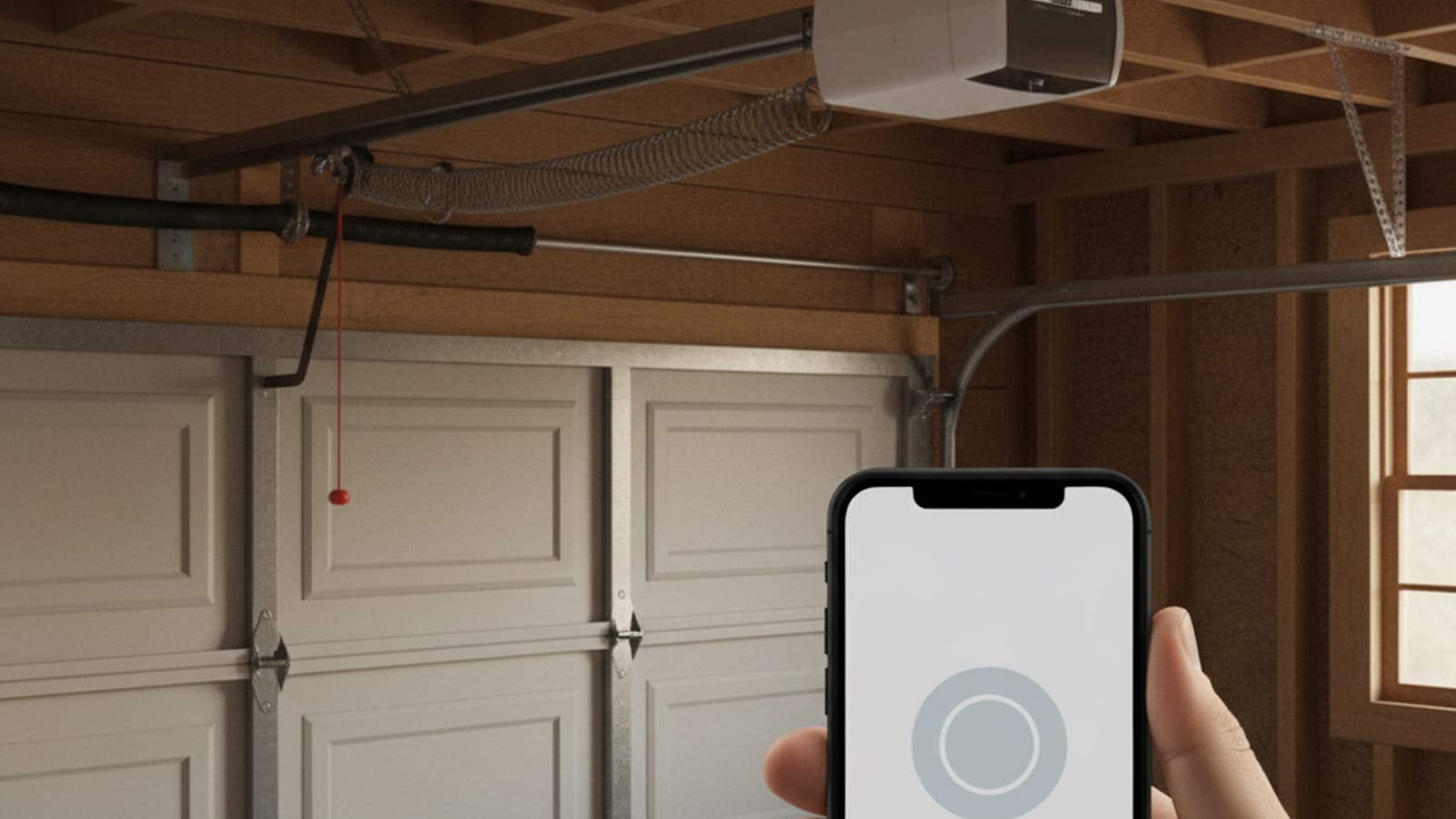
A smart garage door opener solves all three of those. It texts you when the door opens. It lets you see history and open from anywhere. It lets the Amazon driver drop a package inside and close the door behind them. For $480–$950 installed, it’s one of the best home-tech upgrades on the market.
Here’s the 2026 buyer’s guide: who the major players are, what the ecosystems do and don’t do, and what to know about California’s battery backup requirement before you buy.
What does “smart” actually mean on a garage door opener?
At a minimum, a smart Wi-Fi opener gives you:
- App control. Open and close the door from your phone anywhere with internet.
- Status alerts. Push notifications when the door opens, closes, or is left open too long.
- History log. Timestamped record of every open and close, often with the user who triggered it.
- Schedule and automation. Close automatically at 10 p.m., open for a specific person on a schedule.
- Voice control via Alexa, Google Home, or Apple HomeKit
More-premium units add:
- Built-in camera streaming video to the app
- Battery backup (required in California on all new installs since 2019)
- Delivery access via Amazon Key or similar
- Guest access codes for housesitters, dog walkers, contractors
- Integrated LED lighting that doubles as garage illumination
The major smart opener ecosystems
LiftMaster / Chamberlain + myQ
By far the dominant player in the U.S. market. LiftMaster (pro/commercial branding) and Chamberlain (consumer branding) are the same company. Their myQ app platform connects to nearly every LiftMaster or Chamberlain opener made since 2015, sometimes natively, sometimes via a $30 myQ Smart Garage Hub add-on.
Strengths:
- Largest installed base, widest parts availability, most professional installers trained on it
- Amazon Key integration for in-garage delivery (Amazon Prime members)
- Reliable app, decent history logging, solid status notifications
- Many models include built-in battery backup (CA SB-969 compliant)
Weaknesses:
- myQ removed free IFTTT integration in 2021, which frustrated some smart-home users
- Apple HomeKit requires a separate $80 myQ Home Bridge on most models (though newest units are starting to include HomeKit natively)
- Camera-equipped models cost a premium
Good picks:
- LiftMaster 8500W. Wall-mount jackshaft, DC motor, Wi-Fi, battery backup. Great for high-ceiling garages.
- Chamberlain B4603T. Belt-drive, DC motor, Wi-Fi, battery backup, LED corner lights. The best mid-range choice for most homes.
- Chamberlain B6765. Belt-drive with built-in 1080p camera. Premium option for short-term rentals or delivery-heavy homes.
Genie + Aladdin Connect
Genie is LiftMaster’s main competitor. Aladdin Connect is their Wi-Fi app platform.
Strengths:
- Generally $50–$100 cheaper than equivalent LiftMaster models
- Aladdin Connect app is well-regarded, simple interface
- Genie’s direct-drive models (Genie Silentmax) are exceptionally quiet
Weaknesses:
- Smaller dealer network, so some markets have limited Genie-trained installers
- Fewer ecosystem integrations than myQ
- Older Genie models without Aladdin Connect can be retrofitted but the retrofit kit isn’t as clean as myQ’s
Good pick:
- Genie StealthDrive Connect 7155-TSV. Belt-drive, DC motor, Wi-Fi, battery backup. Solid mid-range, cheaper than equivalent Chamberlain.
Sommer: direct-drive, premium
Sommer is a German brand known for direct-drive openers with minimal moving parts and 20+ year lifespans. More expensive to buy, cheaper to own over time.
Strengths:
- Direct-drive means no chain, no belt, no gears to wear out
- Very quiet operation
- Long lifespan (typically 15–20 years)
Weaknesses:
- Premium price, $800–$1,300 installed
- Smart features are good but not as polished as myQ
- Parts availability lags LiftMaster
Wall-mount (jackshaft) specifically
For garages with tall ceilings (12+ feet), cathedral ceilings, or loft storage above the door, a wall-mount opener (jackshaft) mounts to the wall beside the door instead of overhead.
Best picks:
- LiftMaster 8500W. Proven, $780–$1,100 installed, myQ compatible.
- Chamberlain RJO70. Consumer version, $680–$950 installed.
Wall-mount openers ship with battery backup standard.
Third-party retrofit options
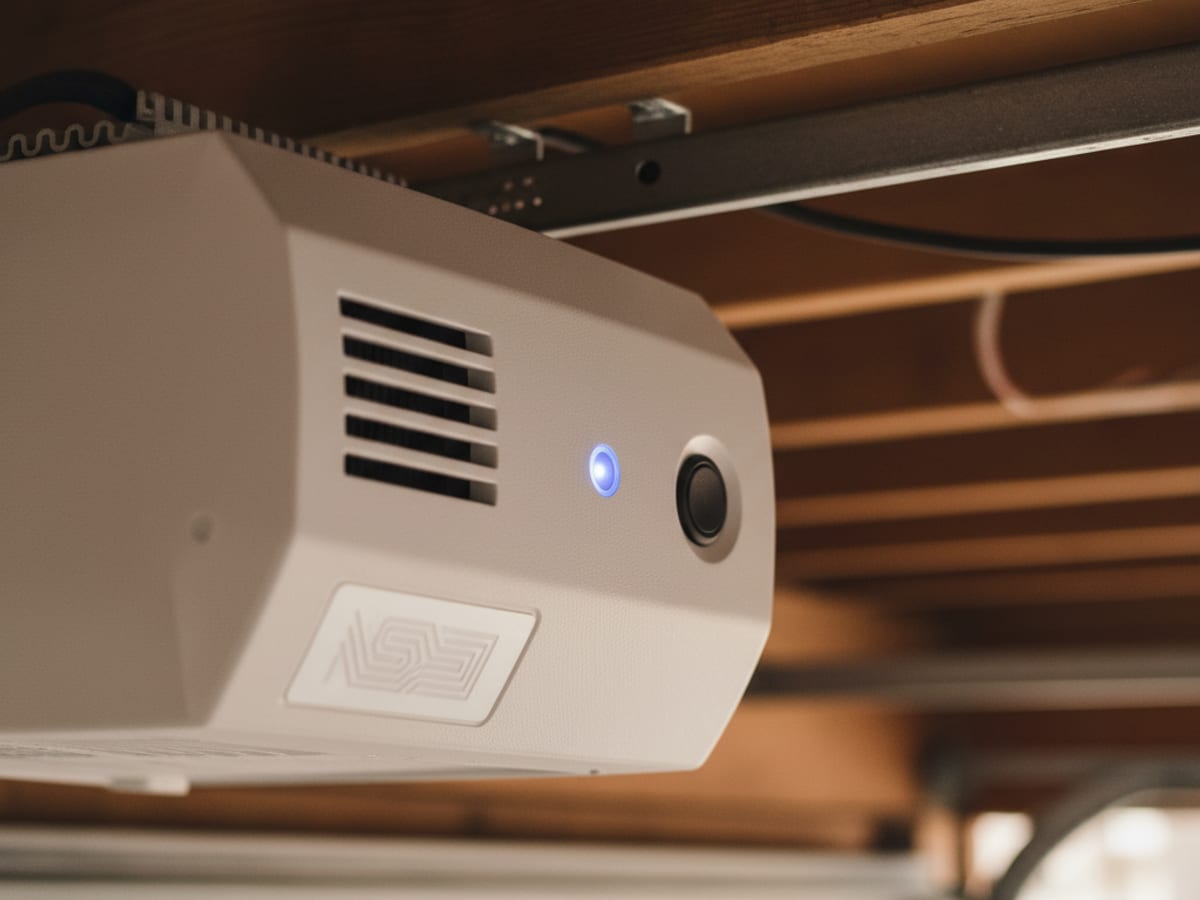
Don’t want to replace your opener? Several add-on devices make existing dumb openers smart. They wire into the opener’s manual button terminals and add Wi-Fi + sensors.
- Meross MSG100. $40–$60, works with Alexa, Google, HomeKit, SmartThings. Solid budget pick.
- Tailwind iQ3. $100–$140, very solid app, battery-free contact sensor.
- myQ Smart Garage Hub. $30–$50, adds LiftMaster/Chamberlain myQ to older LiftMaster, Chamberlain, Genie, Craftsman, Stanley, and Sears openers.
Retrofits are a great middle path if your existing opener is under 8 years old and working fine. At opener age 10+, you’re better off doing a full opener replacement that brings everything current in one job. See our opener lifespan guide.
California SB-969: the battery backup requirement
California Senate Bill 969, effective July 1, 2019, requires all garage door openers sold or installed in California to include battery backup. The intent: during power outages (especially PSPS events during fire season), residents can still open their garages to evacuate vehicles.
What this means for smart opener shopping in 2026:
- Any new opener sold in California must include battery backup. Models without are technically not sold here.
- A compliant opener will have a separate battery pack (usually 12V, user-replaceable, $40–$80, lasts 3–5 years).
- The battery backup is tested during install. Your installer should demonstrate the opener lifting the door with the AC unplugged.
If you’re replacing a pre-2019 opener, you’ll get battery backup whether you specifically ask for it or not. It’s now standard.
Features worth paying extra for
- Battery backup. Required, but also practical during PSPS events and rolling outages.
- LED corner lights. Better garage lighting than the old single-bulb socket, and they’re permanent (no bulb replacement).
- Auto-close timer. The door will close automatically after a set time if you forget. Huge for families.
- History log with user attribution. See who opened the door and when. Valuable for families with kids and housesitters.
- Camera integration. A one-time cost that solves a lot of visibility and security problems. Skip if you already have a garage-area security camera.
Features NOT worth paying extra for
- Excessive remote count. Any opener ships with 2–3 remotes. A family of 5 doesn’t need individual remotes for everyone, because they’ll use phones and the wireless keypad.
- Premium “carbon fiber” belts. Marketing. A quality rubber belt lasts 12–18 years either way.
- “Smart” keypads that do more than pin-code entry. Overkill. A basic wireless keypad with 4-digit codes is all you need.
Installation: what’s included
A professional smart Wi-Fi opener installation in San Diego typically includes:
- Removal and haul-away of the old opener
- New opener installed, rail mounted, belt or chain tensioned
- Travel limits set, auto-reverse calibrated per UL 325
- Wall button installed and tested
- Remotes programmed (usually 2–3)
- Wireless keypad programmed (if included)
- Wi-Fi pairing and app walkthrough with homeowner
- Battery backup tested
Expect 90 minutes to 2 hours on-site. Typical all-in cost: $480–$950 depending on model and whether electrical work is needed.
Frequently asked questions
What’s the best smart garage door opener in 2026?
For most homes, the Chamberlain B4603T (belt-drive, DC motor, Wi-Fi, battery backup, LED lights) at $580–$750 installed is the best value. It hits the CA SB-969 requirement, has the widest installer network, and integrates with the most popular smart-home ecosystems via myQ.
Does every smart opener work with Apple HomeKit?
No. Most LiftMaster and Chamberlain models need an $80 myQ Home Bridge to work with HomeKit. Newer Chamberlain and Genie models have HomeKit built in. Third-party retrofit devices like Meross and Tailwind support HomeKit natively.
Do I need a smart opener to meet California’s battery backup law?
No. The law requires battery backup, not smart features. However, nearly all battery-backup openers sold in California today are Wi-Fi-enabled by default, since the two features arrived together in the product line.
Can I install a smart opener myself?
Technically yes, realistically not recommended. Opener installation involves working at ceiling height, setting travel limits, balancing the rail, and making sure auto-reverse works per UL 325 safety code. Any mistake on the safety side can cause injury. A pro install is $480–$950 all-in, and DIY saves maybe $120 on labor at significant safety risk.
If your opener is 10+ years old, the opener lifespan guide walks through the repair vs. replace decision. For planning a full door + opener replacement, check the new garage door cost guide. And for the maintenance that keeps a new smart opener running smoothly, see the maintenance checklist.
Ready to upgrade? Call Lift Pro SD at (858) 925-5546 for a free smart-opener consultation and install quote. We’re LiftMaster, Chamberlain, Genie, and Sommer installers across San Diego County, from Encinitas to El Cajon.