
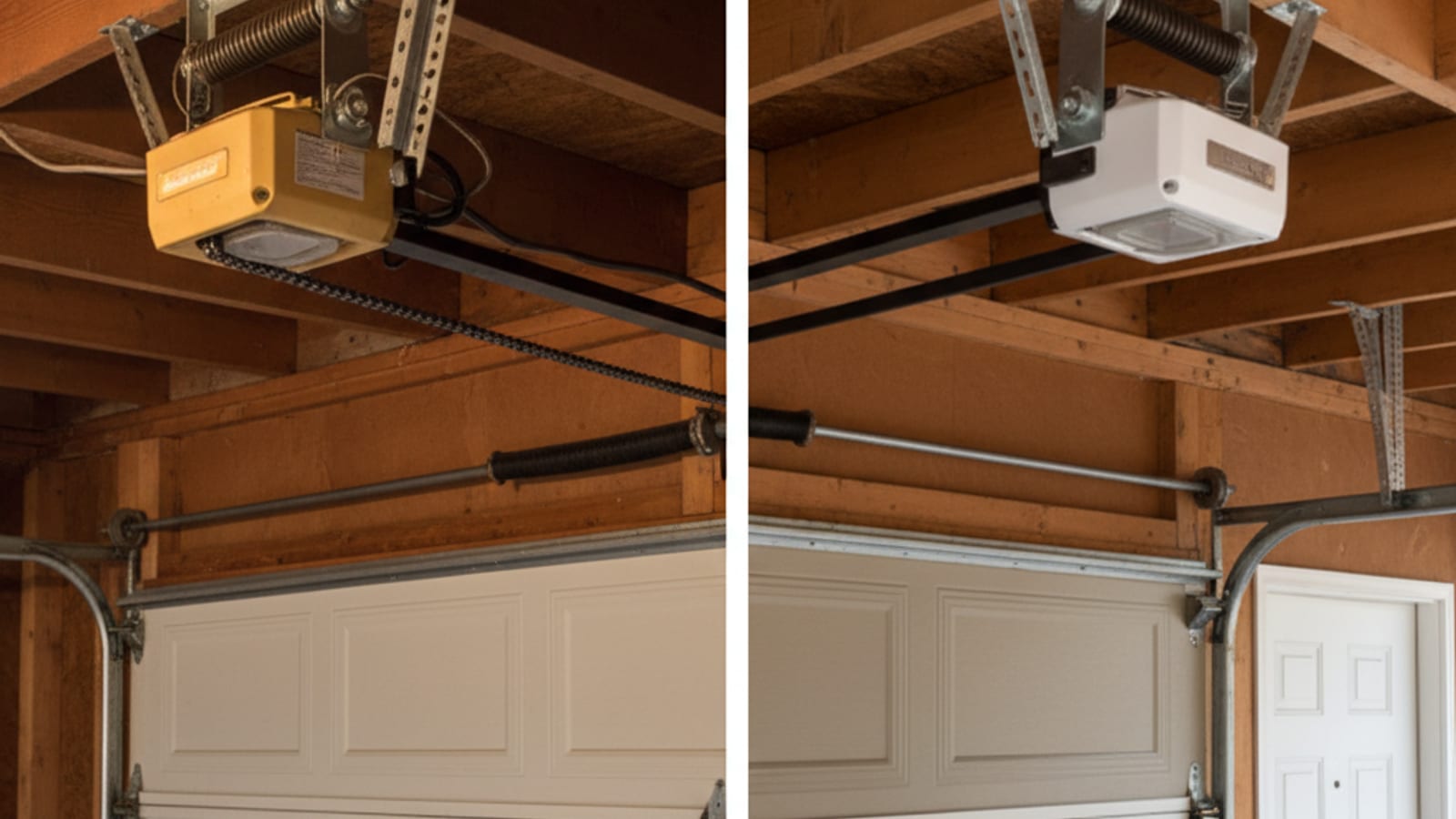
TL;DR
- Most garage door openers last 10–15 years. Chain-drive openers sometimes push 20 with regular maintenance. DC-motor belt-drives typically land at 12–18 years.
- Six signs it’s time to replace: grinding or straining motor, slow operation, intermittent response to remotes, failed logic board, no battery backup (required in CA on new installs), lack of smart features.
- California SB-969 (July 2019) requires battery backup on all newly installed garage door openers. If your opener predates that and it fails, replacement is the path, not repair.
- Repair makes sense for openers under 10 years old with mechanical issues (gears, belts, capacitors). Replace openers older than that or with logic-board failures.
Your opener was installed when you bought the house in 2009. It’s still working. Sort of. It takes three tries to close some mornings. The remote only works from ten feet away instead of the whole driveway. The fluorescent bulb socket corroded out years ago and you’ve been using a flashlight. Is it time?
Here’s how to tell. And here’s what to replace it with if the answer is yes.
How long do garage door openers typically last?
The honest answer depends on the drive type and how you use it. Rough ranges across San Diego County:
- Chain-drive openers: 10–15 years. The chain and sprocket wear, the plastic main gear eventually strips. Older Genie and LiftMaster chain units from the 90s sometimes push 20+ if they were lightly used.
- Belt-drive openers: 12–18 years. Quieter, less maintenance, rubber belt lasts longer than steel chain. Modern DC-motor belt-drives are the longest-lived common design.
- Screw-drive openers: 10–14 years. Good in mild climates like San Diego, rougher in extreme cold or heat. Less common on new installs.
- Direct-drive (Sommer) openers: 15–20 years. Fewer moving parts. Premium price, premium life.
- Wall-mount jackshaft openers (LiftMaster 8500W, Chamberlain RJO70): 12–16 years. Mount on the wall next to the door instead of the ceiling. Good for high-ceiling garages.
A garage used 2 cycles a day is in the lower half of these ranges. A garage used 6+ cycles a day, like a shared family home with kids coming and going, burns through an opener in the upper half.
Coastal homes (La Jolla, Encinitas, Solana Beach, Del Mar) see shorter life than inland. Salt air corrodes logic-board connections and rusts hardware fast. Knock 20% off the ranges above if you’re within 2 miles of the Pacific.
6 signs your opener is at end-of-life
1. The motor strains or grinds
The opener hums louder than it used to. It sounds labored lifting the door. Sometimes the door stops halfway up and you hear the motor struggling.
What’s happening: either the springs are weakening (which makes the door heavier, and the opener can’t compensate) or the motor itself is wearing out. Both possibilities need diagnosis. Have the springs checked first. Spring replacement is often the real fix and saves the opener.
If the springs are good but the opener still strains, the motor windings or capacitor are failing. At year 12+, replacement is usually the smarter math than repair.
2. Intermittent remote response
Remotes work from 3 feet but not from the driveway. Works in the morning, stops by afternoon. Works for one family member’s remote but not another’s even with fresh batteries.
The receiver chip on older logic boards degrades with heat cycles. By year 10–12, the effective range drops. By year 14+, it can drop to near-zero. A new logic board is $220–$420 installed, which is half the cost of a new opener on a unit that’ll be end-of-life in 2–3 years anyway.
3. Slow or jerky operation
A healthy opener moves a residential door in 10–13 seconds door open to door closed. If yours is taking 20 seconds or lurching and pausing mid-travel, the drive gears (plastic main gear on chain-drives, belt drive pulley on belt-drives) are worn.
Gear replacement is $180–$320. Worth doing on an opener under 8 years. Not worth it on anything older, because more things will fail soon after.
4. Logic board failure
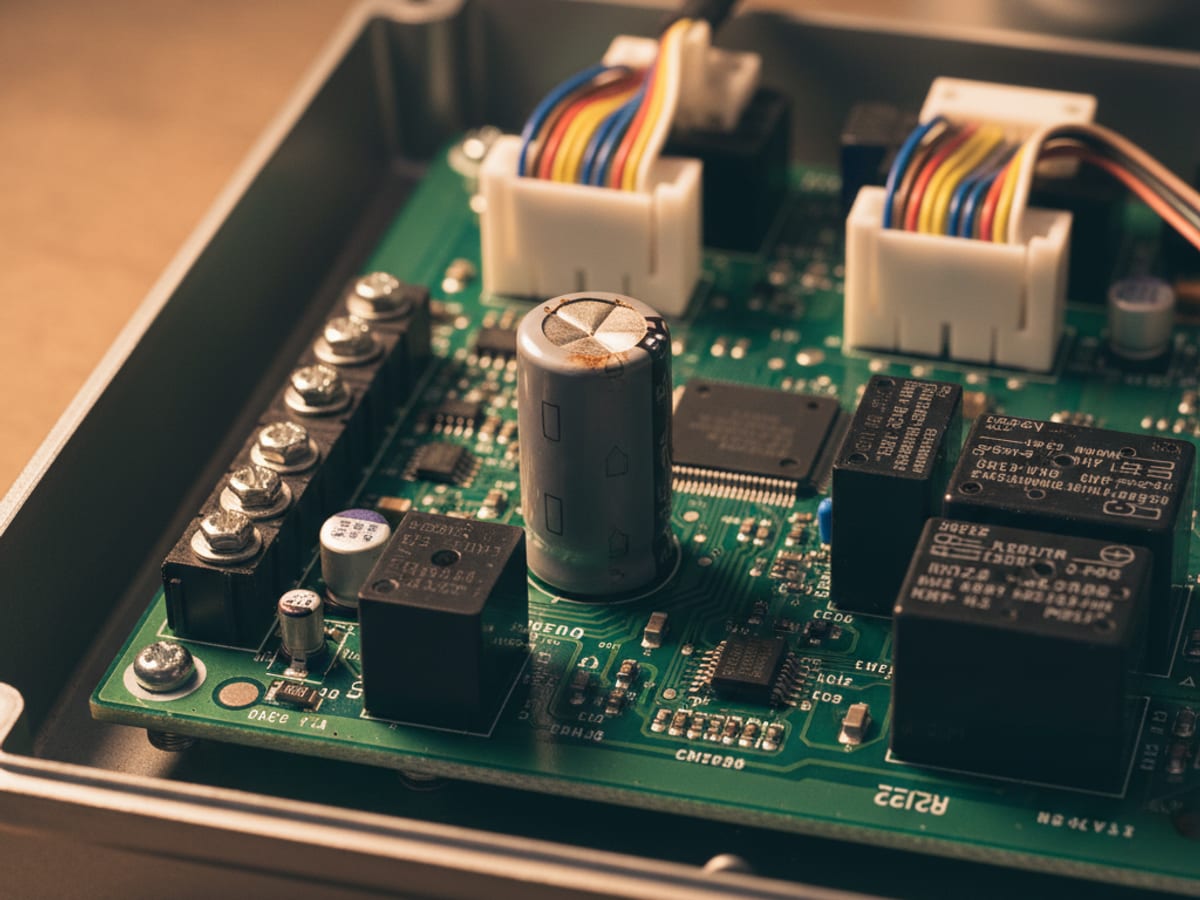
Signs: opener doesn’t respond at all, flashes error codes you don’t recognize, random behavior (closes when it wasn’t told to, lights flicker), or smoke/burnt smell from the motor housing.
A dead logic board on an opener under warranty is a free replacement. On anything older, it’s a $220–$420 repair that puts a new brain in an old body. The rest of the opener is usually on borrowed time anyway, so it’s time to install a new opener.
5. No battery backup (California compliance)
California SB-969 went into effect July 1, 2019. It requires all newly installed garage door openers sold or installed in California to have battery backup, so when the power goes out, you can still open and close the door from the opener without disconnecting it.
Importantly, the law doesn’t force you to rip out a working pre-2019 opener. But if your opener fails and needs replacement, the replacement must have battery backup. And battery backup openers have practical value beyond compliance. SDG&E Public Safety Power Shutoffs during fire season can cut power to whole neighborhoods, and without battery backup, you’re pulling the emergency release cord in the dark.
6. No smart features
Not a failure, but a reason to upgrade. Modern openers integrate with myQ, Aladdin Connect, Apple HomeKit, Google Home, and Amazon Alexa. They send alerts when the door is left open, let you open the door for a delivery, and log history so you can see who opened the door and when.
If you have kids, housesitters, frequent deliveries, or a short-term rental, the smart features pay for themselves inside a year. Full breakdown in our smart Wi-Fi opener guide.
Repair or replace? The 10-year rule
Quick decision framework:
- Opener under 8 years old, mechanical failure (gear, belt, capacitor): Repair. $180–$420.
- Opener 8–10 years old, mechanical failure: Judgment call. If the fix is under $300 and the opener has been solid otherwise, repair. Otherwise replace.
- Opener 10–12 years old, any major failure: Replace. The repair will likely buy you 2–4 years and you’ll spend $300–$400 to get there. A new opener is $480–$850 and buys you another 12–15.
- Opener 12+ years old, any failure: Replace. Without exception.
- Working fine but no battery backup and you want peace of mind: Optional upgrade. Budget $480–$850 installed.
What a new opener costs in 2026
| Opener type | Installed price (2026) | Good fit for |
|---|---|---|
| Chain-drive, basic | $380–$520 | Detached garages, basic residential |
| Belt-drive, mid-range DC motor | $480–$700 | Attached garages, bedrooms over garage |
| Belt-drive with battery backup + myQ | $580–$850 | CA-compliant new install, most common |
| Jackshaft (wall-mount) | $780–$1,200 | High-ceiling garages, low-headroom setups |
| Smart Wi-Fi with camera | $680–$950 | Short-term rentals, deliveries, security |
Full smart-opener deep dive in the buyer’s guide for 2026.
How to make your next opener last longer
- Annual lube. White lithium grease on the rail, drive screw, and chain (chain-drives only, don’t lube the belt). Every 12 months.
- Don’t lube with WD-40. WD-40 is a solvent, not a lubricant. It strips grease off and leaves the parts drier than before.
- Check limit switches every 2 years. A door that’s slamming the floor is wearing out the gear 5x faster than one that lands soft.
- Replace the rubber seal on the bottom of the door. A door that doesn’t seal takes longer to close (opener works harder) and lets weather into the opener housing.
- Check for level and balance annually. A door with weakening springs makes the opener lift more than it was rated for. Springs fail 5–10 years before the opener should, so don’t let them take the opener with them.
Our maintenance checklist walks through the whole year.
Frequently asked questions
How long does a LiftMaster garage door opener last?
LiftMaster belt-drive openers typically last 12–18 years. Chain-drive models are in the 10–15 year range. The newest DC-motor belt-drives with battery backup often push past 15 years with regular maintenance.
Is it worth replacing a 20-year-old garage door opener?
Yes. A 20-year-old opener is past its design life, doesn’t meet California SB-969 battery backup requirements for new installs, and almost certainly uses an older security-code rollover that’s easier to hack. A $580–$850 modern opener pays back in reliability alone.
What’s the most common garage door opener failure?
Capacitor failure (electrical) and main gear stripping (mechanical, chain-drive) are the two most common. Both usually appear between year 7 and year 12.
Do I have to replace my opener to get battery backup?
Yes. Battery backup is not an aftermarket add-on to older openers. It’s built into the power-supply design of the opener itself. California SB-969 requires it on all new installations since July 2019.
For the full new-opener shopping guide, the smart Wi-Fi buyer’s guide breaks down brands and features. Planning the total spend? The repair cost guide shows where opener work fits in the bigger picture. And if your opener strain is actually a spring issue, start with broken spring symptoms.
Opener sounds tired? Call Lift Pro SD at (858) 925-5546 for a free repair-or-replace assessment. The techs we send install LiftMaster, Chamberlain, Sommer, and Genie, same-day across most of San Diego County, including Vista, Escondido, and Chula Vista.