
TL;DR
- Do not try to open the door with the opener. The opener cannot lift the door without spring support and will burn out trying.
- Do not try to lift the door manually without two adults and full awareness of weight (a 180-pound double-car door on a failed spring is dead weight).
- Do not DIY spring replacement. Torsion spring torque can break fingers, launch winding bars across the garage, and in rare cases cause skull injuries.
- Do secure the area, pull the emergency release only if you must move the door, document the damage for insurance if anything else failed with it, and call a pro.
You heard a bang at 4 a.m. that sounded like a shotgun. Or the door made it six inches up the track this morning and quit. Or you pressed the opener and heard a straining groan followed by silence. Welcome to the broken torsion spring club. Everyone who owns a garage door joins eventually.
Here’s the exact playbook for what to do in the first 30 minutes, plus the three mistakes that can turn a $440 repair into a $2,000 hospital bill or a $5,000 door replacement.
Step 1: Confirm the spring is the problem
A broken spring has three tells:
- You heard a loud bang, anywhere from 20 minutes ago to two days ago. The bang is the spring itself failing under tension.
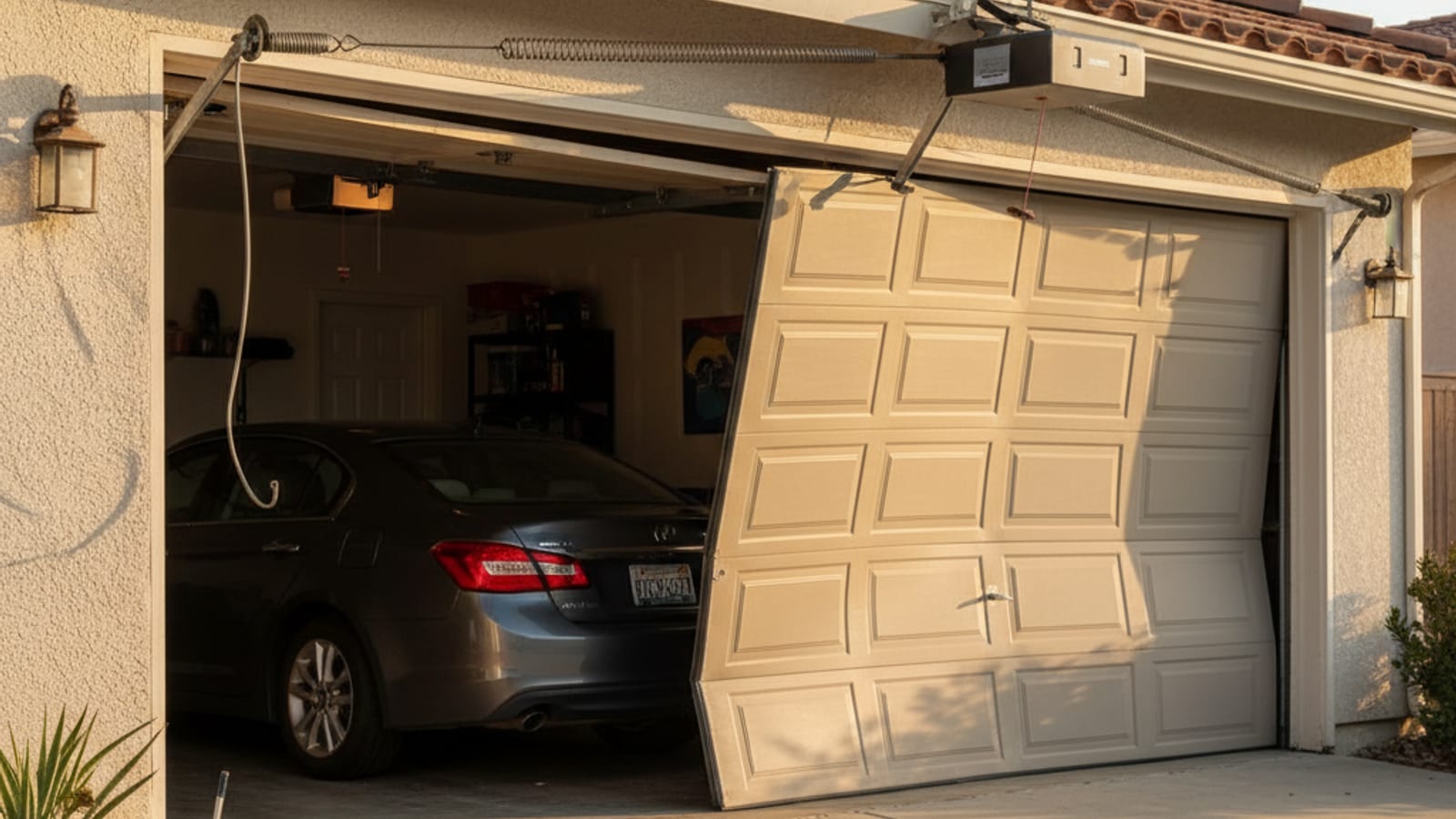
- The door is stuck or hangs at an uneven angle. The side with the failed spring droops. On single-spring systems, the whole door will hang uneven. On dual-spring systems, one side will be lower than the other.
- The opener strains but the door barely moves. The opener is only rated to lift a spring-balanced door. Without the spring, the opener is trying to lift the full door weight, 150 to 300 pounds depending on size and material.
Look at the torsion spring above the door (or the extension springs along the horizontal tracks beside the door). A broken torsion spring shows a 1–2 inch gap in the tightly-wound coil where the metal separated. A broken extension spring may have fallen, is hanging loose, or has visible gaps in the coil.
Step 2: Stop trying to operate the door
This is the single most important thing:
Do not press the wall button or remote again. Every time you do, you risk burning out the opener motor trying to lift a door it wasn’t designed to carry. An opener that starts to burn windings also starts to smell like hot electrical. If you’ve been hitting the button and you smell something acrid, the opener is probably damaged too.
Unplug the opener if you’re worried about someone else in the house pressing the button.
Step 3: Decide if the car needs to come out
If a car is trapped inside the garage and you need it, you have options:
Option A: Leave it and use another car. Call the tech for a morning appointment. Tech arrives, fixes it, you’re back to one car by lunch. Cleanest outcome.
Option B: Pull the emergency release and lift the door manually. You’ll need two healthy adults. Pull the red emergency release cord hanging from the opener rail. This disconnects the door from the opener trolley. Lift the door slowly. On a broken spring, the door is dead weight: a 16’ x 7’ insulated steel door can weigh 180–250 pounds. The door will want to fall fast when you let go, so do not let go with hands or feet below it.
Block the door open with sturdy 2x4s or a pair of ladders wedged under the bottom so it cannot drop while the car rolls out.
Option C: If Options A and B aren’t feasible, call for emergency service. Emergency after-hours repair typically runs $60–$120 more than a daytime call. If your car is blocking a medical appointment or critical commitment, it’s worth it.
Step 4: Do not DIY the spring replacement
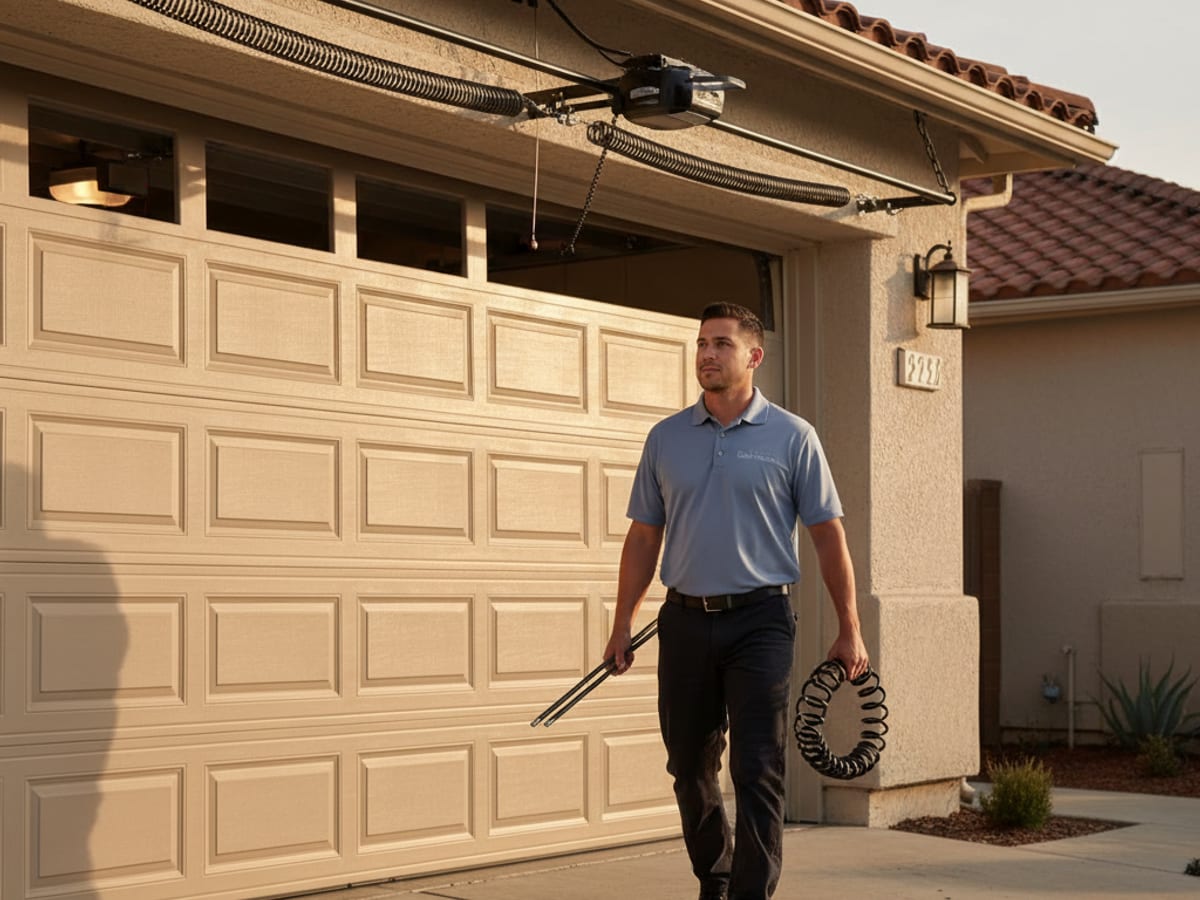
Every garage door tech has a story. The homeowner who watched a YouTube video, bought a “universal spring” from the hardware store, and ended up with a broken finger. The handyman who tried to unwind an old spring with a screwdriver and pliers, and the screwdriver launched through drywall, through a pantry wall, and embedded in a kitchen cabinet 40 feet away. No injuries that time. The time before, a dad lost three fingers.
A wound torsion spring stores roughly 200 foot-pounds of torque. That’s equivalent to a small engine’s peak output, compressed into a coiled piece of steel. The only tools that safely release it are properly-sized steel winding bars, used one at a time with correct hand position, by someone who has done it at least a dozen times.
A mis-sized spring also creates a secondary hazard. Wrong gauge wire fails early, often catastrophically, and the unbalanced load wears out the opener and cables within months.
Save the DIY for hinges, rollers, and weather seals. Spring replacement is a service call, full stop.
Step 5: Document before the tech arrives
If the spring failure was paired with other damage (a panel dented, a cable snapped and whipped the wall, a bracket ripped out), take photos. If anything will be a homeowner’s-insurance claim (a car backed into the door and caused a cascade of failures), photos before any repair starts are critical.
Also note:
- Make and model of the opener (sticker on the motor housing, near the light socket)
- Approximate age of the door
- Brand of the door (sticker on the inside of one of the lower panels)
The tech will want all of this to size replacement parts correctly.
What the service call looks like
A standard emergency garage door repair for a broken spring:
- Call received, tech dispatched. Emergency windows are 90 minutes to 2 hours. Daytime standard appointments are usually same-day.
- Tech arrives, diagnoses. 10–15 minutes. They’ll check the spring, measure wire gauge and length, check the cables, look at the door’s balance history.
- Quote provided before work begins. Flat rate, itemized. You approve or decline before a wrench turns.
- Spring replacement, 60–90 minutes. Both springs replaced if torsion (matched pair). Cables checked and replaced if frayed or rusted. Center bearing replaced if worn.
- Balance test and opener recalibration. The tech lifts the door by hand to waist height and demonstrates it holds position. Opener limits reset to new door weight.
- Walk-through and paperwork. Warranty explained (typically 3-year manufacturer on springs, 1-year labor). Payment.
Total time in your driveway: typically 90 minutes to 2 hours.
What it’ll cost
| Scenario | Typical 2026 cost |
|---|---|
| Matched pair torsion springs replaced, standard door | $440–$620 |
| Matched pair torsion, heavy insulated door | $560–$780 |
| Extension springs + safety cables replaced | $220–$380 |
| After-hours emergency fee | +$60–$120 |
| Cable replacement (needed about 30% of the time) | +$80–$160 |
| Roller upgrade during same visit | +$90–$140 |
Full pricing breakdown in our spring replacement cost guide.
Preventing the next one
A matched pair of new springs bought with a warranty and installed correctly will run you another 10–15 years. Extend that with:
- Semi-annual lubrication. White lithium grease on springs, hinges, and rollers every spring and fall.
- Annual balance test. Disconnect opener, lift door to waist height, confirm it holds. Catches weakening springs before they fail.
- Upgrade to high-cycle springs on the next replacement if you use the door more than 3 times a day. 25,000-cycle springs add 40% to the cost and 2–3x the lifespan.
Full annual routine in our maintenance checklist.
The three things not to do (again)
- Don’t keep pressing the opener button. You’re paying for a second repair, the opener, that didn’t need to happen.
- Don’t try to “just get the car out” by forcing the door with the opener. See #1.
- Don’t DIY the spring. You are not the person who will beat the odds. Pros do this every day and still respect the torque. $440 is cheap compared to the emergency room.
Frequently asked questions
How long can a garage door sit with a broken spring before I fix it?
As long as you need to. The door isn’t going to fail further. Just don’t try to operate it with the opener. Most people get the repair done within 1–3 days.
Can I drive my car out of the garage with a broken spring?
Yes, but with help. Pull the emergency release cord, manually lift the door with two adults, and block it open with 2x4s before driving out. Lower the door manually afterward, and don’t let it slam.
Why did my spring break?
Normal wear. A standard torsion spring is rated for about 10,000 cycles, roughly 10–15 years of typical residential use. Coastal salt air corrosion, heavy doors, or high usage (3+ cycles per day) shortens that. Some springs break on cycle 9,999. Some make it to 15,000. That’s the nature of spring steel fatigue.
Is my homeowner’s insurance going to cover this?
Usually no. Normal wear and tear isn’t covered. If the spring failure was caused by a covered event (car impact, theft, storm damage), then it’s potentially covered under the broader claim. Call your agent to confirm before committing to a repair.
For the full pricing breakdown on spring replacement, read what spring replacement actually costs. If you’re unsure what type of spring you have, the torsion vs. extension guide clears it up fast. And to understand the cost landscape of all garage door repairs, start with the repair cost guide.
Broken spring right now? Call Lift Pro SD at (858) 925-5546. Emergency response 24/7, most calls answered within 90 minutes across San Diego County, including Oceanside, Chula Vista, El Cajon, and everywhere in between.