
TL;DR
- Torsion springs mount on a horizontal shaft above the garage door and twist to store energy. Extension springs stretch along the horizontal overhead tracks on each side of the door.
- Torsion springs are safer, quieter, last longer (10,000+ cycles vs. 7,000–10,000 for extension), and are the modern standard on virtually all new installs.
- Extension springs MUST have a safety cable threaded through the center. If you see extension springs without a cable, that’s a hazard, because when the spring breaks, nothing stops it from launching.
- Both types can and should be replaced only by a trained technician. The stored energy in either system is enough to cause serious injury.
Your spring broke. You called a company. The quote came back and you’re staring at words like “torsion” and “extension” wondering which applies to your door and why the prices are so different. Or maybe you’re buying a new door and the installer is asking which system you want. Let’s make it make sense.
Both springs do the same job: they counterbalance the weight of your garage door so a 180-pound door takes only 10–15 pounds of force to lift. Without them, the door is dead weight and the opener couldn’t move it. But how they do the job, how long they last, how they fail, and how much they cost are all different.
How to tell which one you have
Open your garage with the door closed. Look at the hardware above and beside the door.
Torsion springs: mounted on a horizontal metal shaft just above the top of the door. One or two long springs with a center bearing plate between them. The springs don’t stretch, they twist. Cables drop from cable drums at the ends of the shaft down to brackets at the bottom of the door.
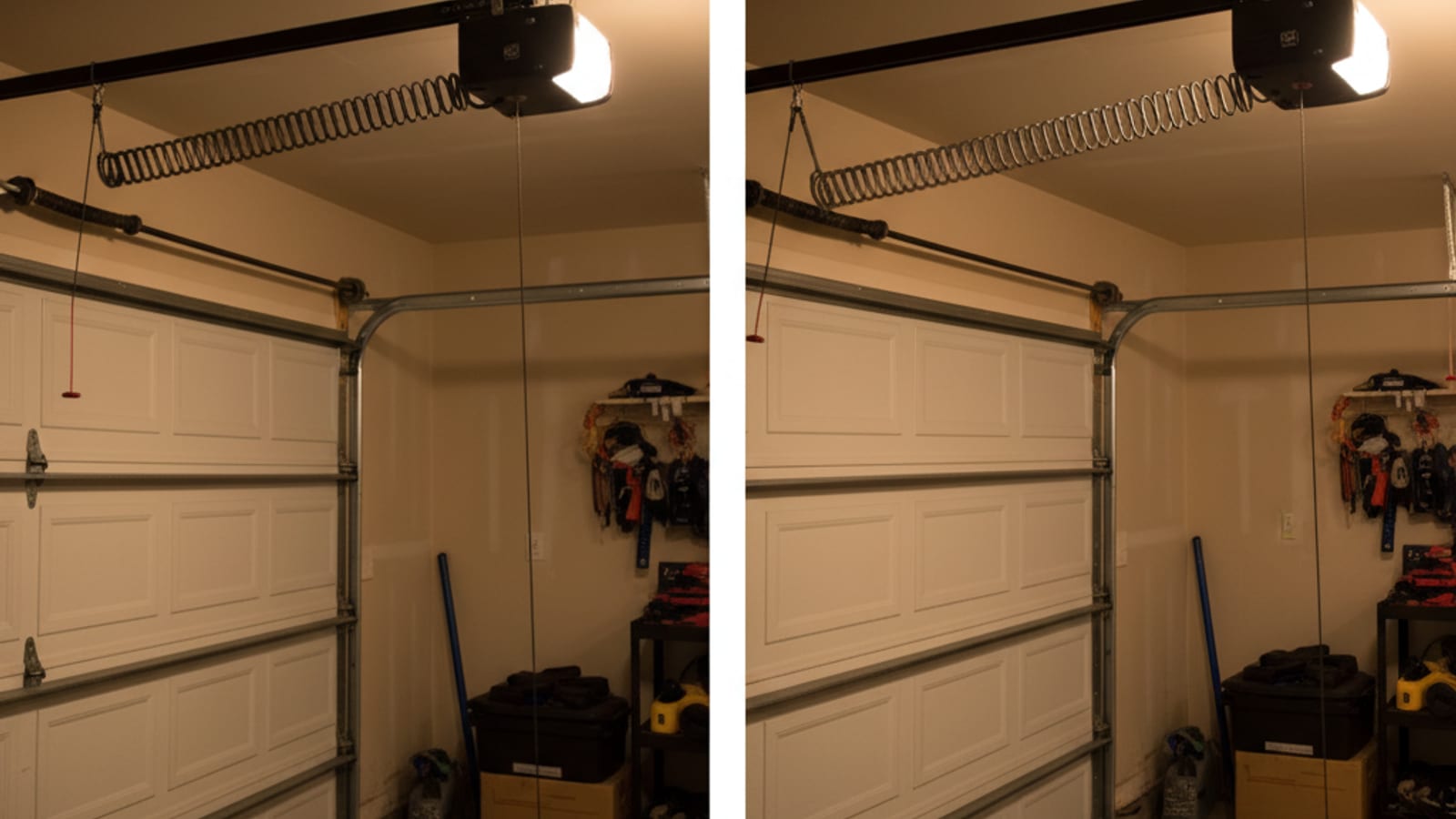
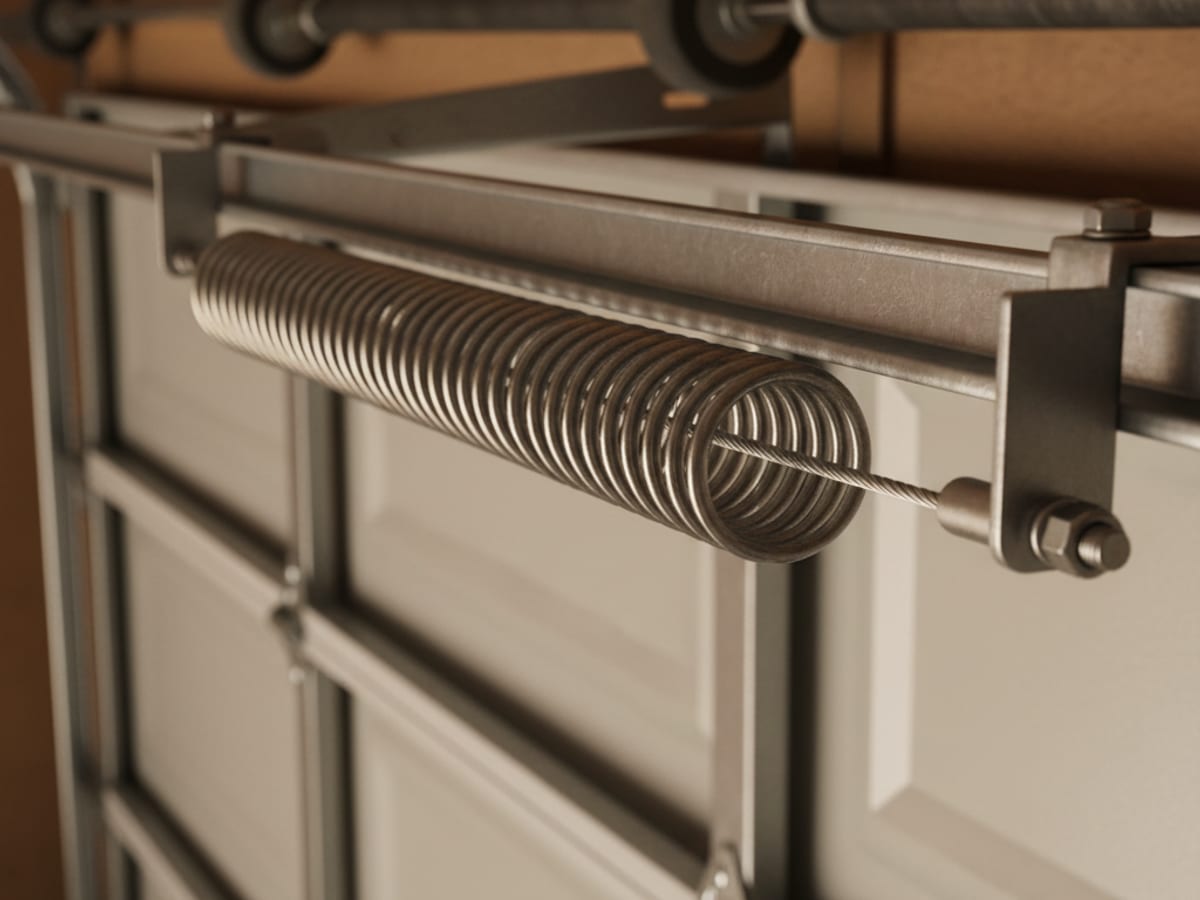
Extension springs: mounted along the horizontal overhead tracks on each side of the door, parallel to the ceiling. Two long springs, one per side, that stretch and contract as the door moves. A thin steel safety cable runs through the center of each spring.
About 85% of San Diego homes built after 2000 have torsion springs. Homes from the 1970s through 1990s often have extension springs. Newer tract-home builds with budget-grade hardware sometimes come with extension springs too.
Why it matters which one you have
Safety
Torsion springs, when they break, make a loud bang and the broken ends stay attached to the shaft. The door becomes unusable but nothing is flying across the garage.
Extension springs, when they break without a safety cable, become unguided projectiles. A stretched extension spring stores enough energy to punch through drywall, break windshields, and cause serious injury. The safety cable running through the center of the spring catches the spring if it breaks. This is why code requires the cable on every extension-spring installation.
If your door has extension springs and no safety cable, that’s a hazard. It’s a $90–$160 fix to add cables, and it should be done the same day you notice.
Lifespan
- Torsion springs: 10,000 cycles standard, 15,000–25,000 on upgraded high-cycle. Translates to 10–15 years of typical use, longer with high-cycle.
- Extension springs: 7,000–10,000 cycles standard. Translates to 7–12 years of typical use.
In coastal San Diego (within 2 miles of the ocean), salt air corrosion knocks both types down 2–4 years.
Quality of operation
Torsion springs give a smoother, more controlled door movement. The twist-based torque delivery is gradual, so the door accelerates and decelerates evenly. Extension springs pull with linear force that’s strongest at full extension and weakest as the door closes, so you’ll notice the door feels less balanced through its travel.
Noise
Both can be quiet when properly maintained. When worn, torsion springs creak. Worn extension springs rattle and clang. Replacing worn springs of either type restores quiet operation. Paired with nylon roller replacement, even an extension-spring setup is whisper-quiet.
Cost to replace
- Single torsion spring: $240–$520 installed
- Matched pair torsion: $380–$720 installed
- Extension springs, pair (with safety cables): $180–$340 installed
Extension springs are cheaper to replace, with a simpler install, less labor, and cheaper hardware. Torsion springs cost more but last longer and fail more gracefully. Over the full lifespan, the cost per year often works out close to even.
Full breakdown in our spring replacement cost guide.
Can you convert from extension to torsion?
Yes. It’s a worthwhile upgrade for most homeowners whose door is currently on extension springs. What’s involved:
- Remove old extension springs, safety cables, pulleys, and hardware. The entire existing system comes out.
- Install a torsion shaft above the door. Requires 10–12” of header clearance above the top of the door. Tight garages may need a low-headroom kit.
- Install center bearing plate and end bearings.
- Install one or two torsion springs (one on lighter doors, two on standard doors).
- Install cable drums and new cables running from the drums to the bottom bracket of the door.
- Wind the springs, balance the door, tune opener limits.
Typical cost in San Diego: $520–$780 for the full conversion on a standard residential door, including new springs, new cables, and all hardware. Budget $680–$950 if the door needs a low-headroom kit.
When it makes sense:
- You’re replacing extension springs anyway and want to upgrade at the same visit
- You’ve had a safety scare (spring broke with no cable, hit wall or car)
- You’re doing a full door replacement, and new doors almost always come with torsion as standard
- The door is used more than 3 times a day
When to stay with extension:
- Door is 15+ years old and likely needs replacement in 3–5 years anyway
- Budget-constrained and extension springs work fine for your use pattern
- Detached or rarely-used garage
Why you should never DIY either type
This gets its own heading because the DIY-injury rate on garage door springs is alarmingly high. Both types of springs store serious energy.
A wound torsion spring stores approximately 200 foot-pounds of torque. An inexperienced attempt at unwinding or winding can launch a winding bar across the garage at 30+ mph. Emergency room visits for garage-door-spring injuries average about 20,000 per year in the U.S. according to the National Safety Council.
A stretched extension spring stores the equivalent energy to an arrow shot from a compound bow. Without the safety cable, a broken extension spring can fly the length of a two-car garage.
Spring replacement is a $240–$720 job done in under 90 minutes by any competent tech with the right tools. The DIY “savings” math does not pencil out.
What to ask when getting a quote
Whether you’re replacing in-kind or converting systems:
- What gauge and length spring are you installing? (Important for matching to door weight)
- Is it a matched pair? (Should be, if you have two)
- Is it standard-cycle (10K) or high-cycle (15K, 25K, 50K)?
- What’s the warranty, parts and labor separately?
- Are new cables and safety cables included? (Safety cables on extension systems, full cables on torsion)
- Will the opener limits be re-tuned after the springs are swapped?
- Is the door balance test included and demonstrated to me before you leave?
That last one, the balance test, is the single most-skipped step in shady spring installs. A balanced door with the opener disconnected stays at mid-height when you let go. A door that slams down or jumps up is wrong. Insist on seeing it.
Frequently asked questions
Which is better, torsion or extension springs?
Torsion springs are better for most homes: safer failure mode, longer lifespan (10,000+ cycles vs. 7,000–10,000), smoother operation, and more compatible with modern openers. Extension springs are still acceptable when installed with safety cables and maintained properly, though they’re cheaper to replace but need replacement more often.
Can I tell the spring type without opening the garage door?
No, you need to see the hardware. With the door closed, look above the door for a horizontal shaft (torsion) or beside the door along the overhead tracks for stretched coils (extension).
Do both sides of a double-car garage door need matching springs?
Yes. Mismatched springs make the door unbalanced, which puts uneven load on the opener and wears rollers and cables unevenly. Always replace springs as a matched pair.
How long does spring replacement take?
Torsion spring pair replacement is 60–90 minutes on-site. Extension spring pair is 45–60 minutes. Conversion from extension to torsion is 2–3 hours.
If you’ve confirmed you have a broken spring, follow the broken spring playbook before doing anything else with the door. For what the replacement will cost either way, see the spring replacement pricing guide. And to avoid the next break, build in the maintenance checklist every spring and fall.
Not sure what type you have? Call Lift Pro SD at (858) 925-5546 and we’ll identify it, price it, and have it replaced the same day. We serve all of San Diego County, from Carlsbad to Chula Vista, La Mesa to Santee.