
TL;DR
- A standard garage door installation takes 3–5 hours for most single-door homes. Double-wide doors run 4–6 hours.
- The tech measures, removes the old door, installs new tracks and panels, mounts the spring, wires the opener, and runs a balance test before leaving.
- Homeowners should clear the garage bay, locate the breaker for the opener circuit, and have their HOA approval in hand (if needed) before the crew arrives.
- Permits are not required for a straight door swap in most San Diego cities, but adding a new opener or structural header work can change that.
- See new garage door costs for pricing before you commit to a model.
Garage door installation is one of those jobs that looks simple from the outside but has a lot of moving parts. A crew shows up and three hours later you have a smooth, quiet, weather-sealed door where an aging rattler used to live. What happens in those three hours matters if you want to know what to clear, what to ask, and what to watch for.
Here’s the full install-day picture, step by step.
How long does garage door installation take?
Single door, single car: 3–4 hours from arrival to cleanup for a straightforward swap (same rough opening, no structural changes).
Double door, two-car: 4–6 hours. More panels, a heavier spring system, and sometimes a dual-opener setup add time.
Add another 30–60 minutes if:
- The opener is being replaced at the same time (wiring, programming, bracket mount)
- The old door tracks are bent or misaligned and need adjustment before the new door goes in
- The header bracket needs repositioning for a new door height
- You’re switching from single to double or vice versa (that’s a structural job, not a swap)
Most of the time the crew gives you a two-to-three-hour arrival window. They carry the panels on the truck and cut nothing on-site, so weather rarely delays the job itself.
What the crew does, in order
1. Measure and confirm
Before any panels come off the truck, the tech re-measures the rough opening, confirms headroom (the space between the top of the opening and the ceiling joists), and side room (space on each side for the track). Standard sectional doors need 10–12 inches of headroom and 3–4 inches of side room. If your headroom is tight, a low-headroom conversion kit solves it but adds about an hour.
They also check the floor for levelness at the opening. A floor that’s off by more than half an inch gets shimmed under the bottom bracket, or the seal will gap on one side.
2. Disconnect and remove the old door
The opener gets disconnected first. Then the tech releases spring tension (torsion spring above the door, or extension springs along the horizontal tracks) before touching any hardware. Never handle a spring under tension without the right tools. This step is why DIY door swaps go wrong.
Panels detach from the hinges and rollers, come down one section at a time, and go stacked flat. Tracks unscrew from the wall jambs. Old hardware (brackets, cables, drums) all come down. If you requested haul-away, it all goes on the truck at the end.
Most crews offer haul-away as part of the installation quote. Confirm this in writing before the job starts. A few outfits will leave the old door unless you ask explicitly.
3. Prepare the opening
The crew inspects the opening for rot, damaged jamb boards, or a sagging header. Minor rot gets noted for the homeowner. A seriously damaged header needs a framing fix before the new door can be set. That’s a separate carpenter visit and adds days, not hours.
New weatherstrip or door stop molding goes on the jambs if the old material is cracked or pulling away. This is included in most full garage door installation quotes. Ask if it’s not listed.
4. Set the tracks
Vertical tracks bolt to the wall jambs. Horizontal tracks attach to angle irons hanging from the ceiling joists and run back parallel to the ceiling. The connection between vertical and horizontal track (the curved section) has to be true for the door to travel without binding.
The crew levels and plumbs both vertical tracks before a single panel goes in. If tracks go in crooked, every panel will bind. It’s a 20-minute step that prevents hours of troubleshooting later.
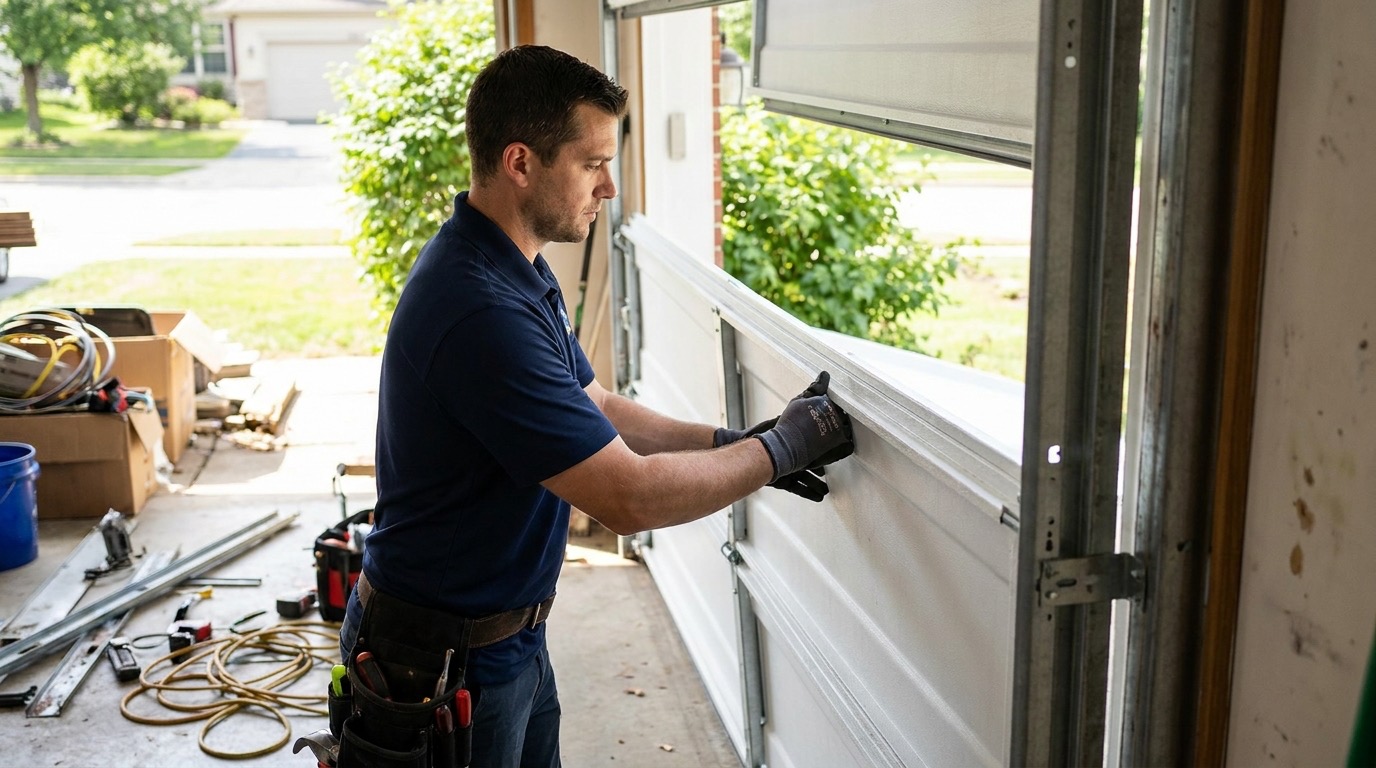
5. Install the panels
Panels go in from the bottom up. The bottom section sits on the floor, hinges get attached to the top edge, and the second panel slides into the hinges from above. Repeat until all sections are stacked. On a 7-foot door that’s typically 4 sections. On an 8-foot door, 5 sections.
Rollers drop into the tracks as each panel goes in. Once all panels are installed, the cables route from the bottom bracket up to the drums at each end of the torsion bar.
6. Mount and wind the spring
This is the most technical part of the job and the main reason installation is a professional call. Torsion springs sit on a steel bar above the door and wind to a specific tension calculated by door weight. Too little tension and the opener strains. Too much and the door shoots up when you pull the release.
Spring winding takes a trained tech with winding bars and a known turn-count for your door weight. If the spring is wrong for your door, it shows up immediately in the balance test. A correct installation has the door holding mid-height by itself when you disconnect the opener and lift by hand.
If you’re also doing a spring replacement on an older opener that’s staying, the crew handles that at the same time.
7. Install or reconnect the opener
If the opener is staying, the tech reconnects the trolley arm to the door bracket, resets the limit switches (how far up and down the door travels), adjusts the force settings, and tests auto-reverse. Auto-reverse is tested by placing a 2x4 flat on the floor under the door. The door should reverse within 2 seconds of contact.
If the opener is being replaced as part of the same visit, add roughly 45 minutes for the opener installation itself: mounting the motor to the ceiling, attaching the rail, running the outlet wire, connecting the wall button and safety sensors, and programming remotes and keypads.
8. The balance test and walk-through
Once everything is installed, the tech does a full balance test: disconnect the opener, lift the door to waist height by hand, let go. It should hold within 6 inches of where you left it. A door that drops fast or shoots up has a spring tension problem.
Then they run the door 3–5 complete cycles on the opener, watching for binding, checking the auto-reverse, confirming the close limit is flush with the weatherseal, and listening for anything unexpected.
Before leaving, a good crew walks you through: remote programming, how to pull the emergency release if power goes out, and what the first year of adjustment may look like (new springs stretch slightly and may need one free tension adjustment within 90 days).
Single door vs. double door: what’s different
A double-wide door (16 feet) is not just two single doors. It’s a single large panel system, one long torsion bar, and almost always requires two springs instead of one. The job runs longer, the hardware is heavier, and the spring math is more complex. If you’re replacing a 16-foot door with two 8-foot doors (or the opposite), that’s an opening modification, not a swap. Budget for framing work.
Do you need a permit for garage door installation in San Diego?
For a direct replacement (same size, same location, no structural changes), most San Diego County cities don’t require a building permit for the door swap itself. The cities of San Diego, Chula Vista, El Cajon, and Escondido all fall into this category for like-for-like replacements.
Where permits come up:
- Changing the opening size. Making a single bay into a double, or widening for an RV door, triggers a building permit because it affects the header.
- Converting the garage. If you’re turning the garage into an ADU or living space and modifying the door opening, permits are required.
- Electrical work. Adding a new 20-amp circuit for the opener requires an electrical permit in most jurisdictions.
When in doubt, ask the tech. A good crew knows the permit thresholds for the city they’re working in. Ask specifically about your city, not “San Diego” in general, because unincorporated county areas and incorporated cities have different rules.
HOA color and style approval
This catches homeowners off guard more than anything else. Most San Diego HOAs require written approval before changing the garage door style, color, or material. This is especially common in:
- Rancho Bernardo (strict on architectural harmony)
- Chula Vista newer communities (specific material lists in CC&Rs)
- Del Mar and La Jolla coastal neighborhoods (historic and aesthetic guidelines)
Get your approval before the install date, not after. A tech who arrives to install a carriage-style door you ordered without HOA approval can’t help you if the HOA sends a violation notice the next week.
What to do before the crew arrives
- Clear the garage bay completely, 10 feet back from the door. Bikes, boxes, and shelving inside the door travel path slow the job and can get damaged.
- Locate the breaker for the opener outlet and label it. The crew will want to kill power before disconnecting the opener.
- Have your HOA approval letter on hand if applicable.
- Know if you want haul-away of the old door and confirm it’s in the quote.
- If you have pets, keep them out of the garage. The work is loud and the door opening is unsecured for most of the job.
What can go wrong
Most installs go smoothly. These are the things that add time or cost:
- Damaged framing or rot in the jamb. Discovered only after the old door comes out. Framing repair adds a day and a carpenter visit.
- Wrong headroom for the spring/track configuration. A site measure before the job should catch this, but sometimes garages have a structural beam that wasn’t in the original spec.
- Existing opener incompatible with the new door weight. Heavier steel doors may overload older opener motors. The tech should catch this during the pre-job consultation, but confirm.
- HOA violation. Door gets installed, HOA requires it be changed. Installation costs don’t come back.
See the garage door repair cost guide for what these add-on repairs typically run.
Frequently asked questions
How long does a garage door installation take?
Most single-door swaps take 3–4 hours from crew arrival to job completion. Double-wide doors take 4–6 hours. Adding opener replacement at the same time adds another 45–60 minutes.
Do I need to be home for the installation?
Yes. The tech needs access to the garage interior throughout the job, will need the opener outlet breaker identified, and will walk you through the finished installation at the end. Don’t schedule this one for when you’re away.
Will the crew haul away the old door?
Most crews offer haul-away as part of the quote. Confirm before the job, not after. It’s worth asking explicitly because some operators leave the old door unless asked.
Can I install a garage door myself?
The panels themselves aren’t the dangerous part. The spring is. Residential torsion springs store enough energy to cause serious injury if they release uncontrolled. The balance test also requires knowing the correct turn-count for your specific door weight. This is one job where professional installation isn’t just convenient, it’s the safe call.
For what a new door costs before you book, the new garage door cost guide for 2026 breaks down pricing by material and style. And once the new door is in, bookmark the maintenance checklist for the twice-a-year routine that keeps it running quietly for 20+ years.
Ready to schedule? Call Lift Pro SD at (858) 925-5546 and a vetted local tech can usually get out same day or next business day. We cover all of San Diego County including Chula Vista, Escondido, and El Cajon.