
TL;DR
- A garage door remote not working while the wall button still works is almost always the remote, not the opener. Start with the battery.
- Most residential remotes use a CR2032 or CR2016 coin cell. They last 1–3 years and fail without warning.
- If a fresh battery doesn’t fix it, reprogram the remote to the opener (takes 60 seconds).
- LED bulbs in the opener housing cause real radio-frequency interference. Swap to incandescent or opener-specific LED bulbs if range has dropped.
- If neither the remote nor the wall button works, the opener itself has lost power or has a logic board fault. That’s a different problem entirely.
- For remote and keypad programming when you’d rather not troubleshoot yourself, the pros in our network handle it in one visit.
Your remote clicks, nothing happens, and now you’re getting out of the car in the driveway. It worked fine yesterday. A garage door remote not working is one of the most common garage door complaints, and in most cases the fix takes less than five minutes. Work through this sequence before calling anyone.
Step one: wall button first
Before touching the remote, press the wall button inside the garage. This tells you immediately whether the problem is in the remote or in the opener.
If the wall button works and the door moves normally, the opener is fine. The fault is in the remote: dead battery, lost programming, antenna issue, or interference.
If neither the wall button nor the remote works, the opener has lost power or has an internal fault. Skip to the “when neither works” section below.
Dead battery: the most common fix
A coin-cell battery in a garage door remote typically lasts one to three years. It doesn’t gradually weaken in a way you’d notice. It works fine up to a point, and then it stops.
Most remotes use one of two coin cells:
- CR2032: the most common. 20mm diameter, 3.2mm thick. Used in LiftMaster 890MAX, Genie ACSCTG Type 3, Chamberlain 953EV, and many others.
- CR2016: same 20mm diameter, 1.6mm thin. Used in some compact two-button remotes.
To replace it:
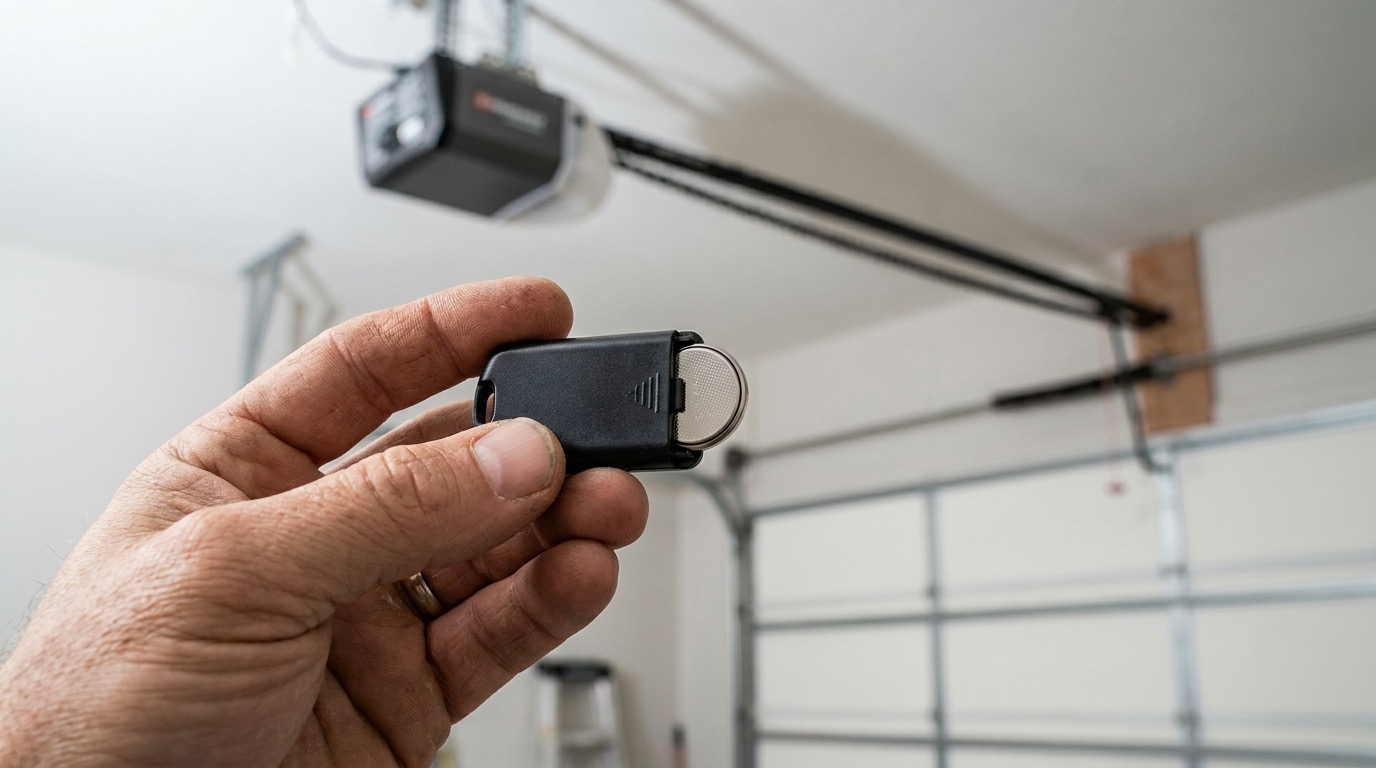
- Find the seam on the back of the remote and look for a small slot or a recessed button. A flathead screwdriver or a coin pops the cover open on most models.
- Note which side of the old battery faces up (usually the ”+” side faces toward the label side of the remote).
- Press the new battery in with the same orientation. Don’t force it.
- Snap the cover closed and test.
CR2032 cells cost under $2 each at any pharmacy or hardware store. Keep a spare in the glove box. This is the first thing to try, every time.
Reprogram the remote to the opener
If the battery is fresh and the remote still doesn’t work, the remote has likely lost its programming. This can happen after a power outage, after pressing the “learn” button on the opener accidentally, or after the opener’s memory was cleared. Reprogramming takes about 60 seconds.
LiftMaster / Chamberlain (yellow, orange, or purple learn button)
- Find the learn button on the back or side of the motor unit, near the antenna wire.
- Press and release it once. The LED next to it glows for 30 seconds.
- Within those 30 seconds, press and hold your remote button until the opener light blinks or you hear two clicks.
- Test from across the garage.
Genie openers (Intellicode)
- Press and hold the program button on the motor until the LED blinks.
- Press your remote button three times. The LED flashes to confirm.
Craftsman openers use the same process as LiftMaster (they’re made by Chamberlain). If the remote won’t accept programming after two tries, the remote itself has likely failed. Replacement remotes run $25–$60.
Antenna wire down from the motor
The antenna is a thin wire, 6–8 inches long, that hangs from the bottom of the motor housing. It picks up the radio signal from your remote. If the antenna wire is coiled up against the motor, tucked behind the housing, or broken off, the remote range drops to almost nothing.
Check it by looking at the bottom of the motor unit. The wire should hang straight down, not looped or bent back up. If it’s been pushed up, pull it down gently so it hangs freely. Test the remote from a normal operating distance. This takes 10 seconds and sometimes recovers 20 feet of range.
LED bulbs and radio-frequency interference
LED bulbs inside the opener housing can interfere with the remote’s radio signal. The electronics in some LEDs emit RF noise on the same frequency remotes use (315 MHz or 390 MHz), and the motor housing amplifies it.
Signs: remote works at 5 feet but fails from the driveway; range dropped right after you changed the bulbs; wall button still works fine at all times.
The fix: swap to incandescent bulbs (60W max) or LED bulbs specifically labeled “garage door opener compatible.” LiftMaster and Chamberlain sell model-specific LEDs that don’t cause interference. This is worth trying before replacing the remote or calling a tech.
Backup battery and lock mode
If the opener is chirping or beeping every 30 seconds, the built-in backup battery is low. Replace it ($30–$60 for the battery itself) before assuming the remote is at fault. A failing backup battery can occasionally cause erratic behavior.
Most LiftMaster and Chamberlain openers also have a lock mode that disables all remote signals, designed for when you’re traveling. Signs: wall button works, remote does nothing, no blinking error code. To disable, press and hold the lock button on the wall console (padlock icon) for 2 seconds. If you use the myQ app, check there too.
When to replace the remote vs. the logic board
Replace the remote if the wall button works reliably, the remote is over 5 years old and reprogramming doesn’t hold, or the remote was dropped or got wet.
Logic board may be the issue if multiple remotes that worked before now all fail together, a power surge happened right before the failure, or reprogramming works but the opener forgets it within a day or two.
Logic board replacement runs $120–$250 in parts. On openers over 12 years old, a full garage door opener installation and repair call often makes more financial sense. Read the opener lifespan guide to compare repair versus replacement cost.
Keypad not working either?
If the exterior keypad stopped at the same time as the remote, the opener’s receiver or a wiped-memory event is the most likely cause. Reprogram both the remote and keypad fresh from the learn button. If they accept programming but lose it within a day, the logic board is failing.
San Diego notes
Coastal humidity in La Jolla, Oceanside, and Encinitas speeds up corrosion on battery contacts. If your remote fails regularly and you’re near the water, open the battery compartment and look for a white or green film on the contacts. A pencil eraser cleans them.
In Poway, Rancho Bernardo, and East County, cold nights can drain coin cells faster in winter. If the remote gets unreliable every December, replace the battery in October as a habit.
Frequently asked questions
Why does my garage door remote only work when I’m right next to the opener?
Short range almost always means one of three things: dead or weak battery, antenna wire folded up against the motor housing, or LED bulb interference. Replace the battery first, then check the antenna wire, then swap out any LED bulbs in the opener housing.
I replaced the battery and reprogrammed, but the remote stopped working again after a week. Why?
If the remote loses programming repeatedly, the opener’s logic board is likely failing. A board that can’t retain memory will erase remote codes on its own. This isn’t a remote problem. Call for a diagnostic before spending money on more remotes.
Can I use a universal remote on my LiftMaster opener?
Yes. LiftMaster uses Security+ 2.0 (rolling code) technology, and there are compatible universal remotes available. Make sure the remote you buy specifies compatibility with Security+ 2.0 or lists your opener model explicitly. The programming process is the same: learn button on the motor unit, then press the remote button within 30 seconds.
My remote works outside but not inside the garage. What causes that?
Metal garage structures and drywall with foil-faced insulation can block or reflect the radio signal. If the signal works approaching from the street but fails once you’re inside, try holding the remote higher or pointing it toward the opener directly. If that doesn’t help, a receiver antenna extension can improve interior range.
If you’ve confirmed the remote is working and the real problem is the door itself, the won’t-close troubleshooting guide and the won’t-open guide cover what comes next. And if this whole situation is reminding you the opener is old, the opener lifespan guide lays out when repair stops making sense.
Remote still dead after all of this? Call Lift Pro SD at (858) 925-5546. The pros in our network reprogram, replace, and diagnose remotes and keypads on the same visit. Same-day service across San Diego County including Carlsbad, Poway, and Encinitas.