
TL;DR
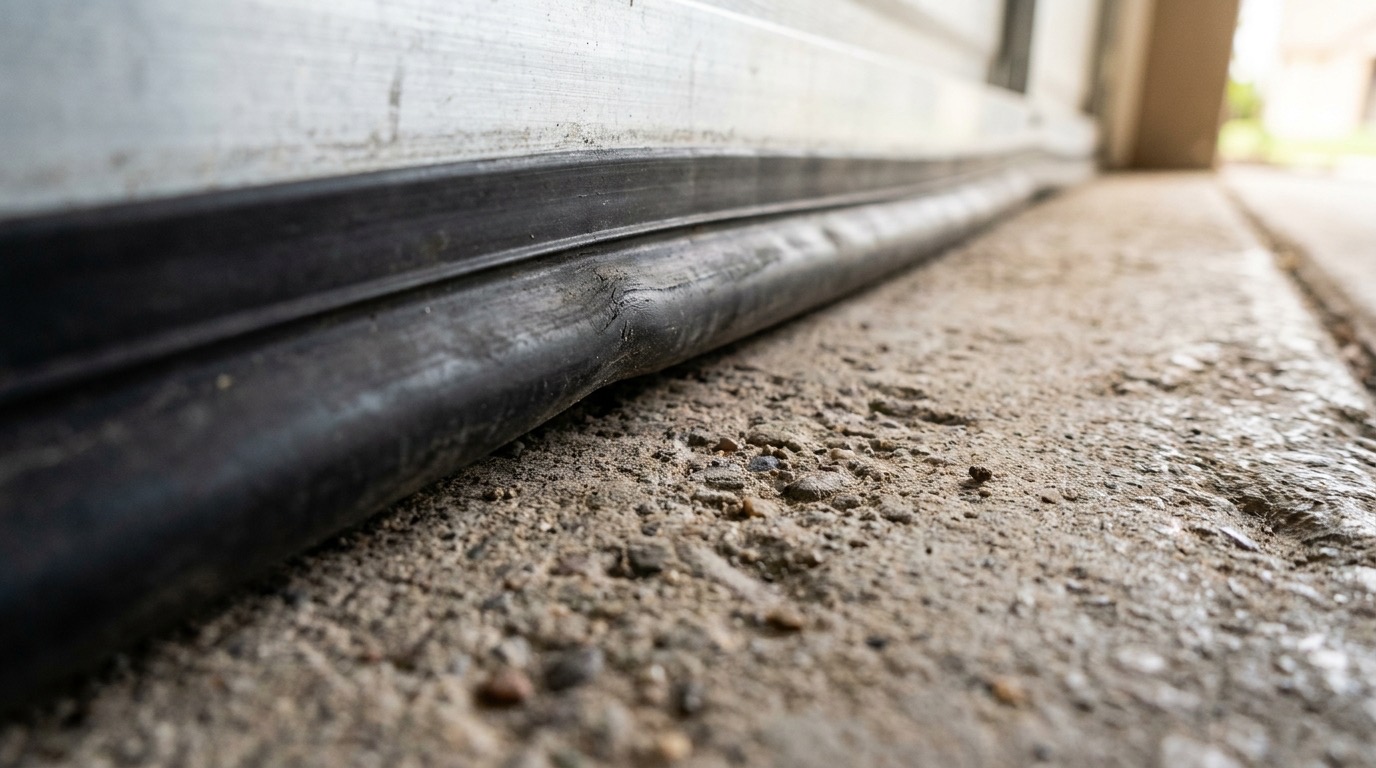
- The garage door bottom seal (astragal) is the rubber strip along the bottom edge of the door. It’s the first thing to fail and one of the cheapest repairs on any door.
- Signs it’s failing: visible daylight under the closed door, water on the garage floor after rain, ants or rodents getting in, leaves and canyon dust piling up inside.
- Two profile types: T-style (slides into an aluminum retainer channel) and bead-style (two beads snap into a track). Measure your retainer before ordering the seal.
- DIY replacement takes 20–30 minutes on most doors. No special tools.
- If your concrete floor is uneven, add a rubber threshold seal. It bridges gaps the bottom astragal can’t compress enough to close.
- For doors with severely deteriorated or missing retainer channels, weather seal replacement by a pro takes care of both the seal and the hardware in one visit.
The garage door bottom seal is the part almost nobody thinks about until the floor is wet. It’s a strip of flexible rubber or vinyl that runs the full width of the door and presses against the concrete floor when the door closes. It keeps out water, cold drafts, desert dust, salt air, and the assortment of insects and small animals that would otherwise treat your garage as a corridor.
In San Diego County, bottom seals take a beating from two directions: winter rain events from the Pacific, and UV exposure from 300 days of sun per year. That combination degrades rubber faster than most people expect.
The parts involved: knowing what you’re replacing
There are four distinct components in a typical residential garage door seal system. Understanding which one failed tells you exactly what to buy.
Bottom astragal seal. The main rubber or vinyl strip itself. It runs the full width of the door and hangs down from the bottom panel. This is the part that contacts the floor. Profile shapes vary, but the two most common are T-style (a T-shaped cross-section) and bead-style (one or two round beads that lock into a groove). This is almost always what fails first.
Aluminum retainer channel. The metal track on the bottom of the door panel that grips the astragal stem or beads. The retainer rarely fails on its own, but a bent or corroded retainer means the seal can’t seat correctly and needs replacing along with it.
Threshold seal. A floor-mounted strip of rubber that the astragal presses against. About 3–4 inches wide and 3/8 inch tall at the peak. It’s the solution when the concrete is uneven and the astragal alone can’t bridge the gap.
Signs your bottom seal is failing
These are the tell-tale signals:
- Daylight visible under the door. Stand inside the closed garage with the lights off during the day. If you can see a strip of light at the floor, the seal isn’t making full contact. A small gap on a door that’s otherwise in good shape almost always means a worn or shrunken seal.
- Water on the floor after SD rain events. San Diego’s winter rain is infrequent but can be heavy. If water is pooling inside the door after a storm, the bottom seal is gone. Coastal cities like Imperial Beach and Oceanside get more wind-driven rain; so do hillside neighborhoods in Rancho Bernardo during Santa Ana-reversal storms.
- Ants, spiders, or rodents getting in. A failed seal is an open door for anything small enough to fit through a 1/4-inch gap. If you’re seeing trail ants along the base of your garage door, check the seal. Canyon-adjacent neighborhoods in Poway, Santee, and Lakeside deal with this more than most.
- Canyon dust and leaves piling inside. A worn seal lets in the fine powdery dust common across inland SD. If your garage floor needs sweeping twice a week, the seal is probably gone.
- The rubber is cracked, stiff, or crumbling. Look at the strip from outside with the door closed. Healthy astragal rubber is flexible and continuous. Failed rubber is hard, brittle, or has chunks missing.
Measuring for a replacement seal
Before you buy anything, figure out what style retainer is on your door. This is the step people skip and then regret.
T-style retainer: If you see an aluminum track with two open lips facing down and the seal slides in from one end, you have a T-style system. Open the door, slide the old seal out, and measure the length. Standard widths are 8 or 9 feet for single-car doors, 16 or 18 feet for two-car. Also measure the T-stem width (usually 1/8 inch, 3/16 inch, or 1/4 inch).
Bead-style retainer: If the bottom of the door has a channel with two round slots and the seal snaps in from below, that’s a bead-style system. Measure door width and bead channel spacing. Bead spacing varies by manufacturer, so bringing the old seal to the hardware store is the most reliable approach.
If you can’t identify the style, take a photo of the bottom edge of the door. Most hardware stores in San Diego can identify it on the spot.
Step-by-step DIY replacement
For most doors, this is a 20–30 minute job.
What you need: replacement seal (correct profile and length), flathead screwdriver, utility knife, and a helper if your door is 16 feet wide.
T-style replacement:
- Open the door. The bottom panel is now at shoulder height, easy to work on.
- Pry out the end cap with a flathead screwdriver and slide the old seal out from one end.
- Clean any debris from the retainer channel. Straighten minor bends with pliers.
- Lubricate the new T-stem with a little dish soap and slide it through from one end. Work in sections on a wide door.
- Trim the excess, leaving 1/4 inch of overhang on each side. Close the door and check contact across the full width.
Bead-style replacement: Open the door, remove the retaining screw or staple at one end, pull the old seal down and out of the channel, press the new seal beads in from one end across the full width, fasten the end bracket, trim, and check contact with the door closed.
If the retainer channel is corroded, bent badly, or missing sections, call a professional. Replacing just the seal on a damaged retainer won’t seal correctly.
When the concrete is uneven: adding a threshold seal
Many San Diego garages, particularly in older Chula Vista, Spring Valley, and Bonita neighborhoods built in the 1970s and 1980s, have floors that have settled unevenly over the decades. A concrete slab that was level at installation may have a 3/8-inch low spot in the middle after 40 years of soil movement.
A standard bottom astragal can’t compress more than about 1/4 inch before the door panel itself starts to strain. If your floor dip is deeper than that, you need a threshold seal on the floor.
Threshold seals are self-adhesive on the bottom. Close the door, mark the floor where the seal contacts, clean the concrete thoroughly (dust prevents adhesion), dry-fit the threshold so it compresses slightly against the seal, peel the backing, press in place, and let it cure 24 hours before cycling the door. A fresh astragal plus a threshold handles even significantly uneven concrete.
Coastal SD: UV and salt air degradation
Standard rubber astragal in coastal San Diego degrades faster than the inland equivalent. UV radiation breaks down rubber compounds over time, and salt air carries chloride ions that attack rubber at the molecular level. A seal that might last 7–10 years in Escondido will last 4–6 years in Carlsbad or Del Mar.
If your home is within a mile of the coast, look for EPDM rubber seals rather than standard vinyl. EPDM (ethylene propylene diene monomer) has much better UV and ozone resistance. Most hardware stores in the area carry it, and the price premium is modest.
When to call a pro instead of DIY
A bottom seal swap is one of the few garage door repairs that’s genuinely homeowner-friendly. Call a pro when:
- The retainer channel is bent, corroded through, or missing. Retainer replacement puts you near the cable tension system, which isn’t homeowner territory.
- The door is a commercial roll-up with a non-standard seal profile.
- The seal issue is paired with the door not closing all the way. That points to a photo-eye or limit switch problem. See why your garage door won’t close for that diagnostic.
For anything beyond a straightforward seal swap, the pros in our network handle garage door repair and full weather seal work in one visit, usually same-day.
Frequently asked questions
How long does a garage door bottom seal last?
Typically 5–10 years for standard rubber in inland San Diego conditions. Closer to 4–6 years on coastal properties due to UV and salt air. Inspect it visually once a year as part of your regular garage door maintenance.
What’s the difference between a bottom seal and a threshold seal?
The bottom seal (astragal) is attached to the door and moves with it. The threshold seal sits on the floor and stays in place. They serve the same purpose but work from opposite sides. Use both when the floor is uneven.
Can I use any rubber seal or does it have to match my retainer?
It has to match your retainer. T-style seals don’t fit bead-style retainers and vice versa. The stem dimensions also matter: too narrow and the seal falls out, too wide and it won’t slide in. Measure or bring the old seal with you when buying a replacement.
Will a new bottom seal lower my energy bill?
Moderately. Garages are unconditioned spaces in most San Diego homes, so the impact is smaller than sealing a door into conditioned space. The bigger wins are keeping bugs out, blocking canyon dust, and stopping water intrusion during winter rain events.
If you’re also seeing light gaps at the sides and top of the door frame, the garage door weather seal replacement guide covers the full perimeter seal system. For the full picture on repair costs across common jobs, the 2026 garage door repair cost guide is a useful reference before you call.
Gaps under the door letting in water or pests? Call Lift Pro SD at (858) 925-5546 and a tech can have a new seal on same-day across San Diego County, including Chula Vista, Poway, and La Mesa.