
TL;DR
- Garage door weather seal replacement in San Diego costs $90–$240 installed for a standard double-car door. A bottom seal alone runs $90–$160. Add a threshold or full perimeter kit and you’re at $180–$280.
- Four seals do the work: bottom seal, threshold seal, side and top weatherstripping, and brush or panel seals between sections.
- Coastal homes in Coronado, Pacific Beach, La Jolla, and Oceanside corrode the aluminum retainer faster than the rubber, so replace both at once.
- Marine layer humidity rusts the retainer and breeds mildew behind a failed seal. Most coastal seals need attention every 3 to 5 years instead of 7 to 10 inland.
- DIY material cost is $15–$60. Most homeowners hire out the bottom seal because the door has to be blocked open and the old retainer fights you.
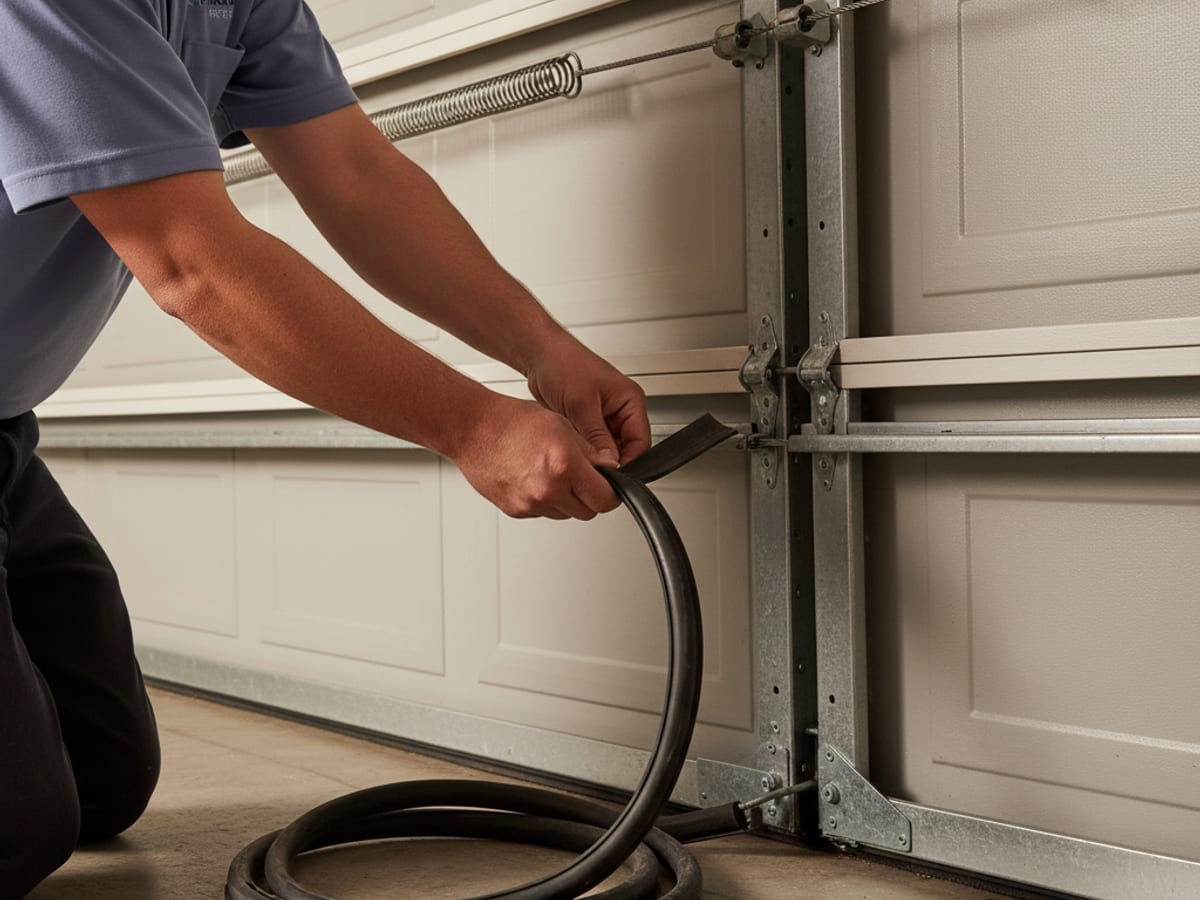
A new garage door weather seal in San Diego costs $90 to $240 installed for a typical double-car door, depending on which seals you replace and whether the aluminum retainer is corroded. A bottom seal swap on its own is $90 to $160. The job takes 30 to 45 minutes. If you’re near the coast, the retainer that holds the rubber usually needs replacing too, which is the part most quotes leave out.
This guide covers the four seals on your door, what each one costs, why San Diego’s marine air wears them out faster, and the HOA and permit reality before you start.
The four seals on your garage door
People say “weather seal” and mean the strip of rubber along the bottom. That’s one of four.
- Bottom seal. The long rubber gasket that compresses against the floor when the door closes. It slides into an aluminum retainer track and is the seal that fails first and fastest.
- Threshold seal. A vinyl or rubber strip glued to the garage floor itself, right where the door lands. Useful on sloped or uneven San Diego driveways where the door can’t make a clean seal. It blocks standing water and windblown sand.
- Side and top weatherstripping. The flexible vinyl flap nailed to the door jamb and header. It closes the gap along the edges and is what keeps the marine layer’s damp air out.
- Brush or panel seals. Thin gaskets between door sections and the bristle strips on some doors. They cut drafts and noise but rarely need standalone replacement.
If you only fix one, fix the bottom seal. It does the most work and takes the most abuse.
Bottom seal types, and how to match yours
The bottom seal slides into a retainer, and the shape of the seal has to match the shape of the channel. Pull a few inches of the old seal out and look at the end profile before you buy anything.
| Seal profile | Retainer it fits | Common on |
|---|---|---|
| T-style (upside-down T) | Double-channel aluminum retainer | Most modern residential doors |
| P-bulb / J-type | Single-channel retainer | Many steel sectional doors |
| Bead / circular | Single-channel slot | Older and some wood doors |
| Triangle / bulb | Varies, measure carefully | Mixed older installs |
Two numbers matter when you buy: the end profile (T, P, bead) and the width of the rubber, usually 3 or 4 inches across. A 4-inch seal on a door built for 3 inches won’t seat right and will fold under itself. Measure the door’s width too. A standard single door is 8 to 9 feet, a double is 16 to 18 feet, and seal comes in matching roll lengths.
If your floor is uneven, which is common on older Mission Hills and North Park concrete, a brush-style or taller bulb seal conforms better than a flat one.
What it costs in San Diego in 2026
Materials are cheap. The labor and the corroded retainer are where the money goes.
| Job | DIY material cost | Installed in San Diego |
|---|---|---|
| Bottom seal only (existing retainer good) | $15–$40 | $90–$160 |
| Bottom seal + new aluminum retainer | $35–$75 | $150–$240 |
| Threshold seal (floor-mounted) | $25–$80 | $120–$200 |
| Side + top weatherstripping (full perimeter) | $20–$50 | $110–$180 |
| Full perimeter kit (bottom + sides + top) | $50–$120 | $180–$280 |
A few things move these numbers. A bent or rusted retainer adds $40 to $80 because it has to come off and a new one goes on. After-hours or same-day calls add a fee. And if the bottom of the door panel itself is rusted through, which we see on neglected coastal doors, you’re into garage door repair territory rather than a seal swap.
We give you the number before any work starts. No “$19 seal special” that turns into $200 once the truck is in your driveway.
Why San Diego’s coast eats seals faster
This is the part the national guides skip, and it’s the part that actually matters here.
Salt air is corrosive. In Coronado, Pacific Beach, La Jolla, Ocean Beach, and Oceanside, the salt doesn’t rot the rubber first. It attacks the aluminum retainer that holds the seal and the steel hardware around it. The rubber can look fine while the channel behind it is pitted and crumbling. Swap the seal without checking the retainer and the new one won’t seat, or it pops loose in a month.
The marine layer does the slower damage. Morning humidity rolls in off the water most of the year. A seal that no longer compresses lets that damp air sit against the inside of the door, which rusts the bottom panel and grows mildew in the garage. Homeowners within a mile or two of the water tend to need seal attention every 3 to 5 years. Inland, in places like Escondido, San Marcos, or El Cajon, a good seal lasts 7 to 10.
UV is the third factor. San Diego sun bakes the exposed bottom seal year-round. The rubber hardens, cracks, and stops compressing. A seal that’s gone stiff and shiny is done, even if it isn’t torn.
If your door is coastal, treat the seal and the retainer as a pair, and put it on the same schedule as the rest of your garage door maintenance checklist.
Signs your seal needs replacing
- Daylight under the door when it’s fully closed.
- Water, leaves, or sand blowing into the garage during a storm or a windy day.
- The rubber is cracked, torn, flattened, or hard and shiny instead of flexible.
- A draft you can feel along the bottom or sides.
- Rodents or bugs getting in. A failed bottom seal is the most common entry point.
- Rust streaks on the bottom panel or a retainer that flakes when you touch it.
One quick test: close the door, go inside the garage in daylight, and look along the bottom and edges. If you see light, you have a gap.
HOA and permit reality
Two things San Diego homeowners ask about.
HOA rules. Most HOAs don’t care about a seal swap since it isn’t visible from the street. But if you’re replacing visible side weatherstripping or anything that changes the door’s look, check your CC&Rs. Many SD County HOAs, especially in Carmel Valley, 4S Ranch, and Santaluz, regulate garage door color and trim. A clear or color-matched seal keeps you out of trouble.
Permits. A weather seal replacement needs no permit anywhere in San Diego County. It’s a maintenance repair, not a structural change. You only get into permit territory with a full door replacement that alters the opening or any electrical work on a new opener. So a seal job is free of red tape.
Frequently asked questions
How long does garage door weather seal replacement take? A bottom seal swap takes 30 to 45 minutes. A full perimeter kit with side and top weatherstripping runs 60 to 90 minutes. If the retainer is corroded and has to be replaced, add 20 to 30 minutes.
Can I replace the bottom seal myself? Yes, if the retainer is in good shape. You feed the new seal into the channel with the door blocked open, usually with soapy water as a lubricant. Most people stall when the old seal is brittle and tears, or the retainer is rusted and won’t release the old rubber cleanly. That’s when a coastal homeowner calls us.
How often should I replace it in San Diego? Within a mile or two of the coast, every 3 to 5 years. Inland, 7 to 10 years. UV and salt air are the deciding factors, not the calendar.
Does a new seal lower my garage temperature? It helps, but a bottom seal isn’t insulation. It stops drafts, water, and pests. If you want a noticeably cooler garage in the inland heat, that’s an insulated door, not a seal.
What’s a threshold seal and do I need one? It’s a strip glued to the floor that the door closes against. It’s worth it on a sloped or cracked driveway where the door can’t make clean contact, which is common on older SD County concrete. On a flat, smooth floor, a good bottom seal is enough.
Will salt air ruin a new seal fast? The rubber holds up fine. It’s the aluminum retainer and steel hardware that corrode. Replace both together near the coast and you’ll get the full life out of the new seal.
Get a straight quote
If your door’s letting in light, water, or the marine layer, we’ll replace the seal and check the retainer while we’re there. Upfront pricing, same-day availability across San Diego County, and we know what salt air does to a coastal door. Call Lift Pro SD at (858) 925-5546, or read more about our weather seal replacement service.