
TL;DR
- Worn rollers are the number-one cause of garage door noise, jerky travel, and rust dust on your floor.
- Nylon rollers with sealed bearings are the correct upgrade for almost every San Diego home. They run quieter and last longer than steel.
- Cost for a professional cable and roller replacement is $140–$280 installed, usually a one-hour job.
- Nine of the ten rollers on a standard door are homeowner-replaceable. The bottom-bracket roller is not. It sits under spring tension and can cause serious injury if mishandled.
- Salt air on coastal SD doors accelerates corrosion. Nylon sealed-bearing rollers are the right long-term answer in Oceanside, Carlsbad, and La Jolla.
Garage door roller replacement is the single highest-return maintenance job on a residential door. Most homeowners don’t think about rollers until the door starts grinding, lurching, or pulling off track. At that point, the bearings have already worn past safe operation. Knowing the signs early keeps a $200 fix from becoming a $600 repair.
What rollers actually do
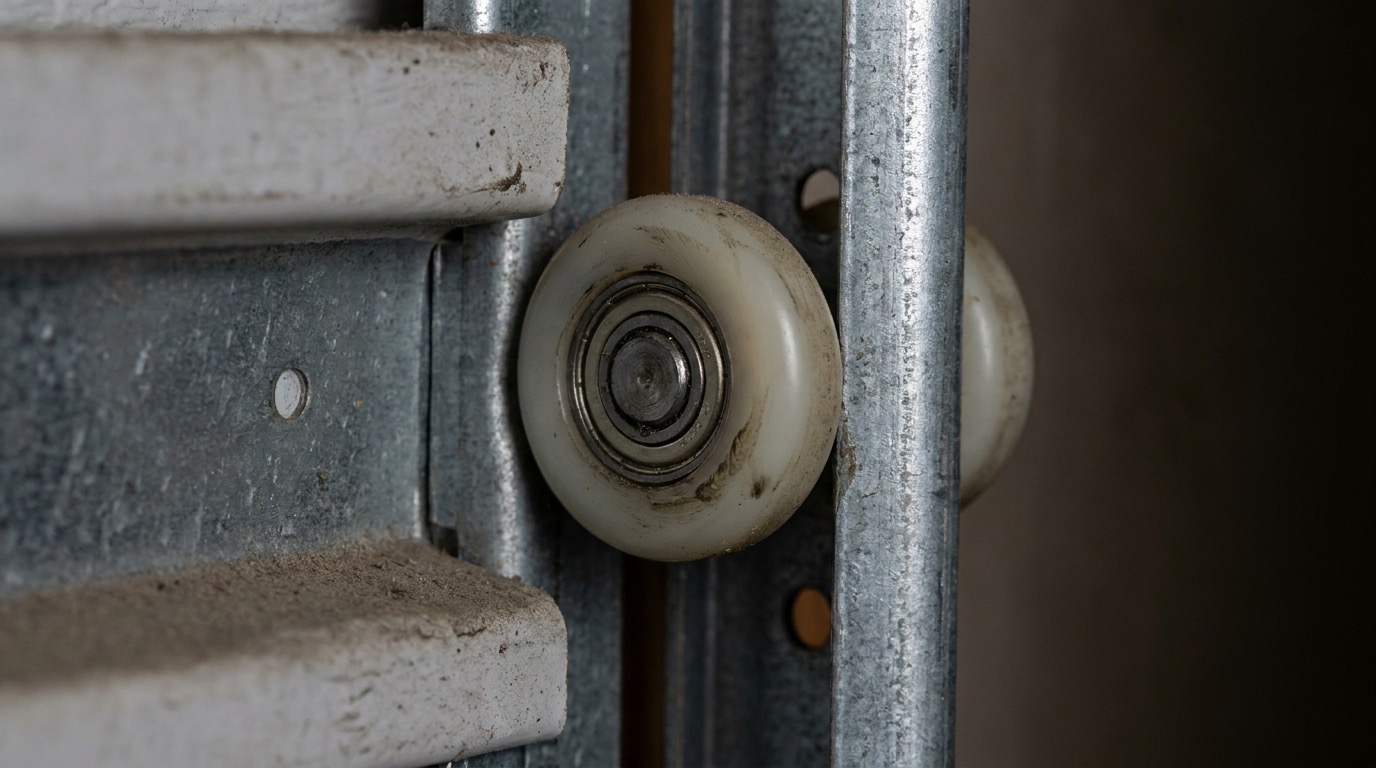
Rollers are the round wheels that ride inside the vertical and curved sections of the track on each side of your door. A standard two-car sectional door has ten of them: two per horizontal panel section, one on each side. They carry the full weight of the door during every cycle, converting the lifting force from the springs into smooth linear travel along the track.
A healthy roller spins freely on its bearing with almost no side play. An unhealthy roller wobbles, drags, or seizes. When one roller binds, the door panel on that side lags behind the others, and the door comes out of level or drifts toward the binding side.
The bearings inside the roller are the failure point. On cheap steel rollers, the bearings are exposed to dust, humidity, and on coastal San Diego doors, salt air. They rust, corrode, and eventually seize. On quality nylon rollers with sealed bearings, the bearing cartridge is enclosed and keeps grease in and contamination out.
Signs your rollers need replacement
Check these before assuming something more expensive is wrong:
- Rumbling or grinding noise during operation. Not a clunk (that’s hardware or springs) but a continuous rolling grind that tracks the door’s position as it moves up or down.
- Rust dust on the track or on the floor below the track. That’s bearing material and rust flaking off worn steel rollers. A clear sign the rollers are at end of life.
- Jerky or uneven travel. One side of the door moves faster than the other. The door hesitates at specific points in its travel. The opener sounds like it’s straining more than usual.
- Door drifts off track or rubs the track on one side. A seized roller on one panel forces the door to skew sideways. Left uncorrected, this leads to a full garage door off-track repair.
- Visible wobble in a roller. Close the door and look at each roller from the side. Grab any accessible roller and try to wiggle it perpendicular to the track. More than a millimeter of play means the bearing is shot.
- Roller stem is bent or cracked. The stem is the metal axle the roller spins on. A bent stem causes a repetitive clunk every time that panel passes the curved section of track.
Steel vs nylon rollers: what’s on your door now and what to install
Most homes built before 2015 came with 10-ball or 13-ball steel rollers from the factory. They’re cheap at the wholesale level, they’re loud, and they corrode.
Nylon rollers with sealed bearings are the upgrade that almost every professional recommends today. Here’s why:
- Quieter operation, typically 50–70% noise reduction versus worn steel
- No rust. The nylon wheel itself doesn’t corrode, and the sealed bearing keeps moisture out
- Longer service life: 12–15 years for quality nylon versus 6–8 for steel under San Diego conditions
- Smoother travel because the nylon wheel has more give than steel on the track
The trade-off is cost: nylon rollers run $8–$18 each at the part level versus $2–$5 for steel. On a full door of ten rollers, the price difference at retail is roughly $60–$130 in parts. That difference disappears when you consider the labor is the same either way and nylon rollers last twice as long.
Coastal SD consideration. If your home is within two miles of the coast, in Carlsbad, Del Mar, La Jolla, Coronado, or Oceanside, the salt air is aggressive on any exposed metal. Steel rollers that might last 8 years in Escondido or El Cajon will last 4–5 years near the beach. The sealed-bearing nylon upgrade is especially worth it on coastal homes.
Cost breakdown: what to budget
A full garage door roller replacement on a standard two-car door, all ten rollers swapped to nylon with sealed bearings, runs $140–$280 installed in San Diego County. That range reflects differences in roller quality, whether any tracks need adjustment, and travel distance for the tech.
What that price includes:
- Removal of all ten old rollers
- Installation of ten nylon sealed-bearing rollers
- Track inspection and minor alignment adjustments
- One test cycle with door balance check
If cables show fraying during the swap, the tech will flag it. Cables and rollers are often done together since the labor overlaps. See the garage door repair cost guide for full cost context across common repairs.
Which rollers a homeowner can DIY (and which one they can’t)
Here’s the honest breakdown:
Rollers you can replace yourself: rollers 1 through 9, working from the top panel down. These rollers sit in the track with no significant spring tension acting on the bracket. To replace one, you disconnect the opener, manually hold the door at the correct height, unscrew the hinge plate, slide the old roller stem out of the hinge hole, insert the new one, and reassemble. A DIY-comfortable homeowner can replace all nine in about 45 minutes with a socket set and a flathead screwdriver.
The roller you should not touch: the bottom roller, on each side, inside the bottom bracket. The bottom bracket is the point where the lift cable attaches. That cable is under the full tension of your torsion or extension springs. Removing or adjusting a bottom bracket with a charged spring is dangerous. The bracket can snap free with enough force to cause serious injury. This is the one task on a roller replacement job that belongs to a tech with the training and tools to safely release spring tension first.
If you’re DIYing the top nine and leaving the bottom two for a professional, that’s a completely reasonable approach. Call (858) 925-5546 and a tech can knock out those bottom brackets as a quick service call.
What happens if you ignore worn rollers
Worn rollers don’t fail safely. They fail progressively, and each stage of failure creates a new problem:
- Noisy but functional. Bearings are worn, door still travels.
- Door starts drifting off track. Panel misalignment puts side load on cables.
- Cable frays from the off-track load. Now you have a cable repair on top of a roller replacement.
- Roller seizes completely. Door stops mid-travel or comes off track, and you need emergency garage door repair.
A $180 roller replacement at stage 1 becomes a $450 roller-plus-cable repair by stage 3. Catching it early is the cheaper path.
East County and inland SD: the heat factor
Coastal homes deal with salt corrosion. Homes in El Cajon, Santee, Alpine, and Ramona deal with high summer temperatures. Garage temps in East County regularly hit 110–120°F in July and August. That heat cycles the metal in roller stems and brackets, accelerating wear on any roller that wasn’t adequately lubricated. If your door faces south or west in an East County neighborhood, check rollers every 3 years rather than every 5.
How rollers fit into full door maintenance
A roller swap is a good time to also check:
- Hinges for cracked or bent pivot points
- Cables for fraying at the drum or the bottom bracket anchor
- Spring balance by disconnecting the opener and checking if the door holds position at mid-height
- Track alignment for bends or gaps between track sections
Our garage door maintenance checklist covers the full twice-a-year inspection routine. Following it extends the service life of rollers, cables, and springs together.
Frequently asked questions
How long do garage door rollers last?
Steel rollers in San Diego typically last 6–8 years under normal use, less if the door sees salt air or extreme heat. Nylon rollers with sealed bearings last 12–15 years. If you don’t know when your rollers were last replaced and your door is over 10 years old, have them inspected.
Can I just lubricate steel rollers instead of replacing them?
You can lubricate them to reduce noise short-term, but lubrication doesn’t restore worn bearings. White lithium grease on the stem helps for a few months. If the bearings are already grinding or showing rust dust, the rollers need replacement, not just lube.
Will new rollers stop my garage door from being noisy?
In most cases, yes. Worn rollers are the number-one noise source on residential garage doors. Swapping ten steel rollers for nylon with sealed bearings typically drops door noise 50–70%. If significant noise remains after a roller swap, check the opener for worn gears or a loose rail, as covered in why is my garage door so noisy.
Do both sides need replacing at the same time?
Yes. Rollers wear at similar rates since they share the same load and the same number of cycles. Replacing one side and leaving the other uneven causes the door to travel slightly off-balance. Always do all ten at once.
If you’re also seeing cable wear alongside the roller damage, the garage door cable repair guide explains what to watch for. For the full picture on garage door repair options, the service page covers what’s typically combined in a single visit.
Ready to stop the grinding? Call Lift Pro SD at (858) 925-5546 for same-day roller replacement across San Diego County. Techs serve Carlsbad, Vista, and Escondido the same day.