
TL;DR
- Garage door cable repair in San Diego runs $130–$290 for one cable, $190–$420 to do both sides. Most calls are done in under an hour.
- Replace cables in pairs. The second one has the same age, rust, and wear as the one that just snapped.
- Coastal salt air is the number one cable killer in San Diego. Homes in Coronado, Pacific Beach, La Jolla, and Oceanside corrode cables years faster than inland homes.
- A broken cable can leave the door jammed crooked with a loaded spring still under tension. Don’t force it. That’s the dangerous part.
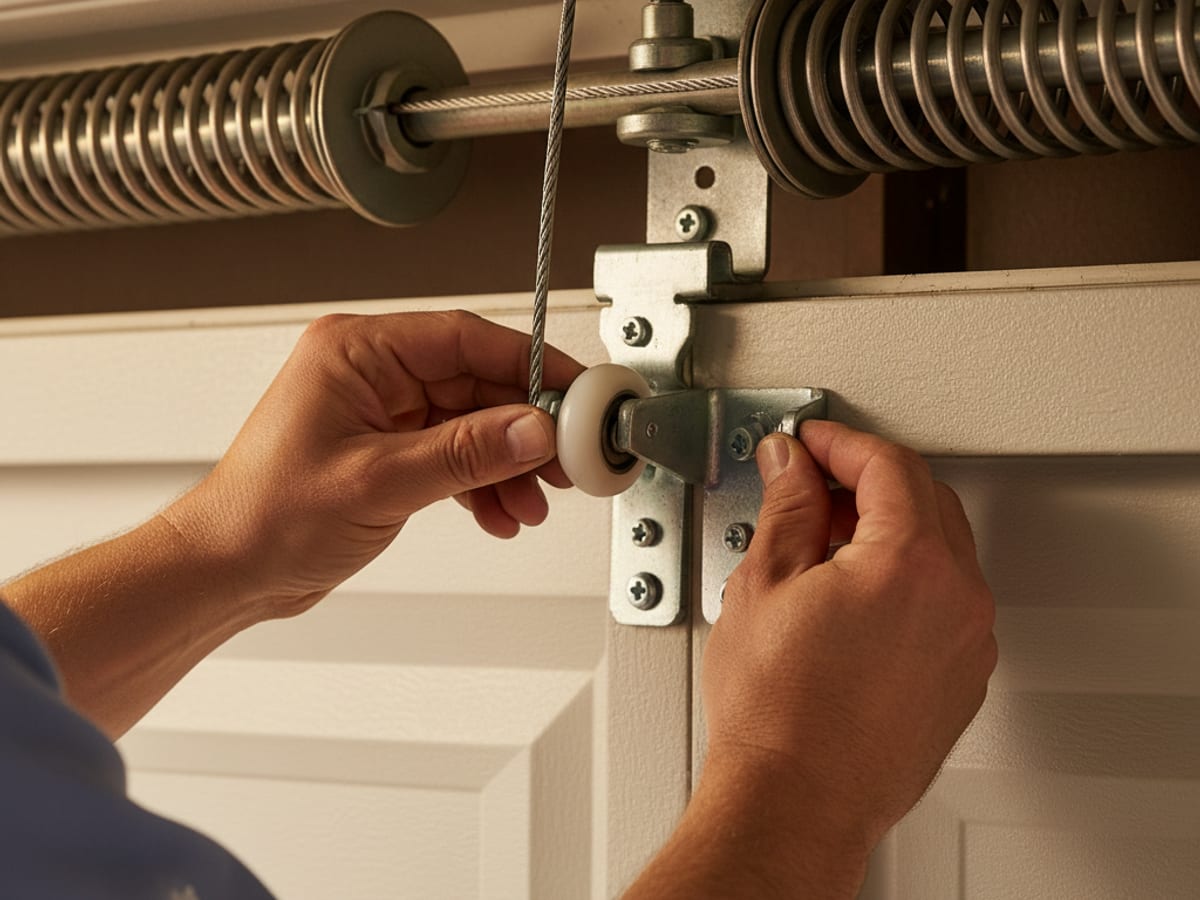
Garage door cable repair in San Diego runs $130 to $290 for one cable and $190 to $420 to replace both sides, including labor. Most jobs take 30 to 60 minutes. If your door is hanging crooked, stuck halfway, or has a steel wire dangling near the bottom corner, you’ve got a snapped or slipped cable. Here’s what it costs to fix, why San Diego homes lose cables faster, and what to do right now.
How much does garage door cable repair cost in San Diego?
Cable repair is one of the cheaper garage door fixes. The cable itself is inexpensive. You’re mostly paying for the labor and the safety risk of working around loaded springs.
| Job | Installed price (2026) |
|---|---|
| Single lift cable, standard door | $130–$220 |
| Single lift cable, heavy or insulated door | $180–$290 |
| Both lift cables (matched pair) | $190–$340 |
| Both cables, heavy or coastal-corroded setup | $290–$420 |
| Cable + drum replacement (one side) | $240–$420 |
| Cable + safety cable on extension-spring door | $170–$300 |
| Emergency or after-hours surcharge | +$60–$150 |
These are real San Diego County numbers, not national averages. A few things move the price:
- One cable or two. Always quote the pair. More on why below.
- Drum damage. If a cable jumped the drum and chewed it up, the drum gets replaced too. That adds $60–$140 per side.
- Corrosion spread. On a coastal door, the tech often finds rusted rollers and a worn spring at the same visit. Fixing those together costs less than three separate trips.
- Door weight. A solid-wood or insulated steel door needs heavier cable and takes longer to balance.
If you want the full picture across every part, see our San Diego garage door repair pricing guide.
Why San Diego eats garage door cables
Cables are braided steel. Steel rusts. And San Diego’s coast pumps salt into the air every single day.
Salt-laden marine air settles on the cable, works into the braid, and corrodes it from the inside where you can’t see it. The cable looks fine on the surface, then snaps without warning. This is the same reason coastal springs and rollers wear out early, and it follows a clear geographic pattern across the county.
Homes within a mile of the water take the hardest hit. Coronado, Pacific Beach, Mission Beach, La Jolla, Ocean Beach, Imperial Beach, and the Oceanside and Carlsbad coastline all see cables corrode in 5 to 8 years instead of the 10 to 15 a steel cable should last. The morning marine layer makes it worse. That damp gray blanket that rolls in overnight keeps metal wet for hours, and wet salt corrodes faster than dry salt.
Move inland and the clock slows down. El Cajon, Santee, Poway, Escondido, and the inland valleys are dry enough that cables often outlast the springs. If you’re coastal, plan on a cable inspection every couple of years, not every decade.
What a failing or broken cable looks like
Cables rarely give much warning, but there are signs:
- The door hangs crooked. One side dropped, the other didn’t. That’s a snapped cable on the low side.
- A steel wire is dangling near the bottom corner of the door or pooled on the floor.
- The door is stuck partway and won’t go up or down evenly.
- Frayed strands poking out of the cable, often near the bottom bracket where water collects.
- Rust streaks running down the cable, a coastal tell that corrosion is already inside the braid.
- A loud snap or pop when the door was last used, then trouble.
Cable problems get confused with spring problems and off-track doors all the time. If your door simply won’t close and nothing’s obviously broken, start with our won’t-close troubleshooting guide first. If you heard a bang like a gunshot, that’s usually a spring, and the broken-spring guide covers that.
Why you replace both cables, not just one
The broken cable and its twin came off the same spool, got installed the same day, and have carried the same load through the same salt air. When one fails, the other is rarely more than a few months behind.
Doing both at once also costs less than two separate visits. You pay one trip charge, one diagnostic, one balance test. A second emergency call three weeks later costs far more than the small upcharge to do the pair today. This is the same logic that applies to spring replacement, and for the same reason.
Why cable repair is not a DIY job
This is the honest part. Garage door cables run right next to the springs, and the springs are under enormous tension.
On a torsion-spring door, a wound spring stores hundreds of pounds of force. On an extension-spring door, the spring is stretched tight along the track. A snapped cable can leave that energy loaded with nothing holding it in check. Release it wrong and a winding bar, a bracket, or the cable itself can launch across the garage.
A working cable also balances the whole door. Re-spool it loose or uneven and the door slams shut or rockets up. There’s no margin for “close enough” on a 150-pound steel door over your car and your family.
This is the difference between cable repair and a simple maintenance task you can do yourself. Lubing rollers is a homeowner job. Cables and springs are not.
How long does cable repair take?
A standard single-cable swap runs 30 to 45 minutes. Both cables with a balance test, 45 to 60 minutes. If a drum needs replacing or the door has to come off the track to re-thread, budget 60 to 90 minutes.
Here’s the rough breakdown for a matched-pair job:
- Inspection and door safety check: 10 minutes
- Releasing tension and removing old cables: 10–15 minutes
- Threading and spooling new cables on both drums: 15–20 minutes
- Balance test and travel adjustment: 10 minutes
- Walk-through and cleanup: 5 minutes
Frequently asked questions
How long do garage door cables last in San Diego?
Inland, a steel lift cable lasts 10 to 15 years. Within a mile of the coast, salt-air corrosion cuts that to 5 to 8 years. Beachfront homes in Coronado, Pacific Beach, and La Jolla are on the short end. Have coastal cables inspected every two years.
Can I use my garage door with a broken cable?
No. A broken cable throws the door off balance and leaves the spring tension unmanaged. Forcing the opener can snap the second cable, bend the track, or drop the door. Disconnect the opener and leave the door alone until it’s fixed.
Is it cheaper to repair the cable or replace the whole door?
Cable repair, by a wide margin. Cables are a $130 to $420 fix. A new door starts around $1,200 installed. Replace the cable and the door has years of life left. If you’re weighing a full replacement for other reasons, see our new garage door cost guide.
Why did my cable snap if the door looked fine?
Coastal cables corrode from the inside of the braid where you can’t see it. The surface looks okay while the steel underneath is rusting through. That’s why salt-air homes need inspections on a schedule, not just when something looks wrong.
Do I need a permit to replace a garage door cable?
No. Cable repair is a routine maintenance fix, not a structural change, so no permit is required anywhere in San Diego County. Permits only come into play for a full door-and-opener installation that touches the structure or electrical. HOA rules can dictate door color and style on a replacement, but they don’t reach a cable swap.
Should I replace the rollers and check the spring while the door is open?
Often, yes, especially on a coastal door. Salt corrodes cables, rollers, and springs on the same timeline. If the tech already has the door apart, swapping worn rollers or a tired spring in the same visit saves a second trip charge.
A snapped cable is a same-day fix, not a wait-and-see. Call Lift Pro SD at (858) 925-5546 for an upfront quote and same-day cable and roller repair. We stock cables and drums in every common size on the truck, so most calls are fixed in one visit. Same-day across San Diego County, from Oceanside to Coronado to Chula Vista.