
TL;DR
- Start with the cheap stuff. Dead remote battery, a tripped breaker, or an engaged manual-release cord cause more “won’t open” calls than broken parts.
- Listen to the opener. If the motor hums but the door won’t budge, that’s usually a broken spring or a stripped opener gear, not the motor.
- Look for a gap in the torsion spring coil above the door. A broken spring is the single most common real repair, and it’s not a DIY job.
- In San Diego, salt air speeds all of this up. Coastal homes in Coronado, PB, and La Jolla rust springs and cables years faster than inland.
Your car is trapped inside and the door won’t move. Before you panic, check three things in this order: the remote battery, the breaker for the garage outlet, and whether someone pulled the red emergency-release cord. Those three fix a surprising number of “won’t open” calls in under five minutes. If the door still won’t open, the cause is usually a broken spring, a stripped opener gear, or a track problem, and the rest of this guide walks you through finding which.
About half the won’t-open calls we run in San Diego County turn out to be a spring or cable that gave out early because of coastal corrosion. We’ll get to why that happens here specifically. First, the fast checks.
1. Dead remote or keypad battery
The most common cause, and the cheapest. If you press the remote and nothing happens, no motor hum, no opener light, the opener may simply not be getting a signal.
- Try the hardwired wall button instead of the remote. If the wall button works, your remote battery is dead. Swap it (most use a CR2032 or A23 12V).
- If the outdoor keypad doesn’t beep, change its 9V battery.
- Try a second remote or your phone app if you have a smart opener. One working control narrows the problem to the dead one.
This is a two-minute, zero-dollar fix. Don’t skip it just because it feels too simple.
2. Power loss to the opener
If neither the remote nor the wall button does anything and the opener light is off, the opener has no power.
- Check that the opener is still plugged into the ceiling outlet. Vibration and curious kids unplug these more than you’d think.
- Check the breaker panel. The garage outlet shares a circuit that can trip when a freezer, compressor, or power tool kicks on.
- Test the outlet with a phone charger or lamp. Dead outlet means an electrical problem, not a garage door problem.
San Diego’s older coastal homes in places like Ocean Beach and parts of Encinitas sometimes have aging garage circuits. If the breaker keeps tripping when the opener runs, stop. That’s a sign of a motor pulling too much current, and it needs a tech.
3. The emergency release is engaged
Every opener has a red cord hanging from the rail. Pull it and the door disconnects from the opener so you can move it by hand during a power outage. The catch: once it’s pulled, the opener motor runs but the door doesn’t move, because the trolley is disconnected.
If you hear the motor run and the trolley slides but the door stays put, this is almost certainly it. To re-engage, pull the red cord toward the door (not down), or run the opener once and the trolley usually re-latches on its own. Some models need you to pull the cord back toward the motor.
4. A broken torsion spring
This is the most common real repair we see, and in coastal San Diego it shows up early. The springs above your door do almost all the lifting. The opener just guides a balanced door. When a spring breaks, the door becomes 150 to 250 pounds of dead weight the opener can’t lift.
Signs of a broken spring:
- A loud bang from the garage earlier, often overnight. That’s the spring snapping.
- A visible gap in the coil of the torsion spring mounted on the bar above the door.
- The opener hums and strains, the door lifts an inch or two, then stops or reverses.
- You can’t lift the door more than a few inches by hand even with the opener disconnected.
Do not keep pressing the button to force it. You’ll burn out the opener gear or motor trying to lift a load it was never built for. A broken spring is under high tension and is dangerous to replace yourself. See what to do with a broken spring for the full breakdown.
5. A cable off the drum or a snapped cable
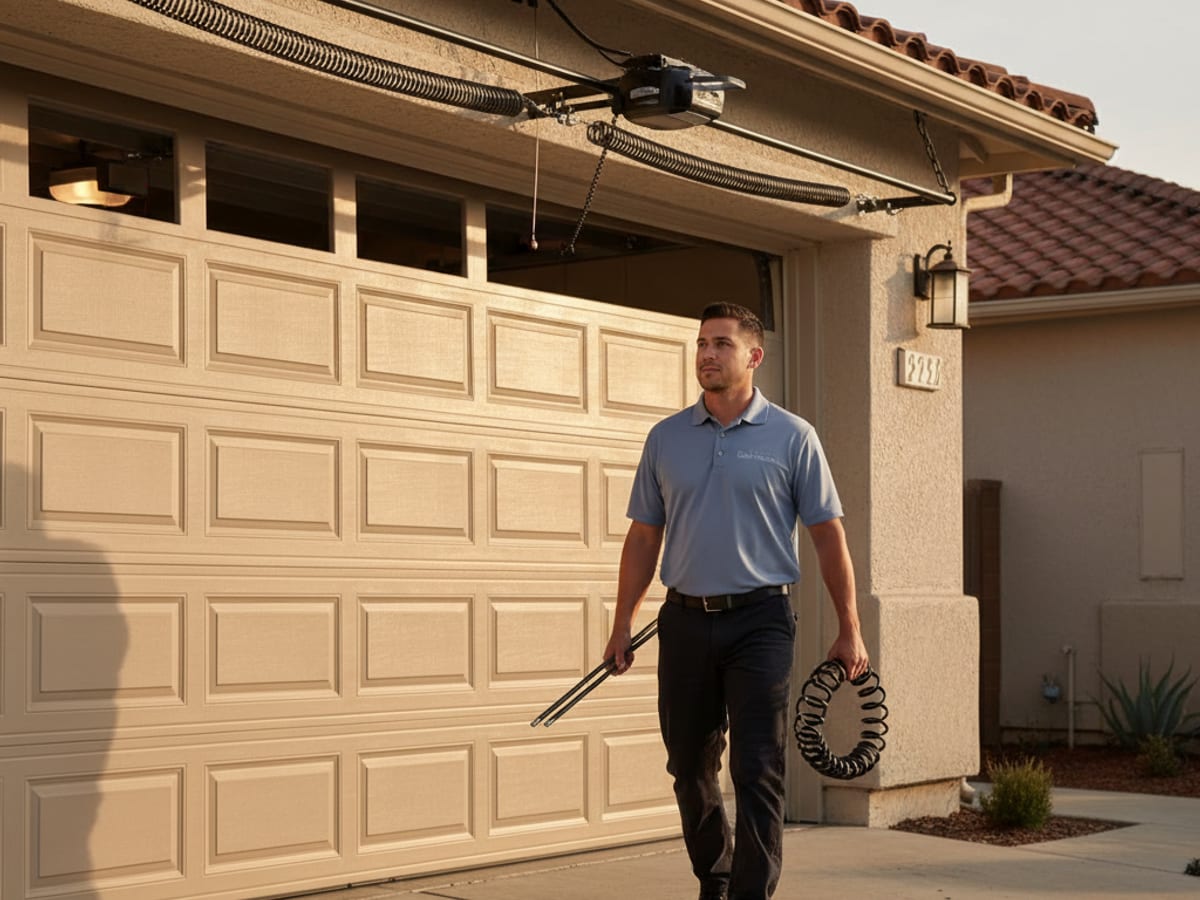
The lift cables run from the bottom of the door up to drums near the springs. Salt air corrodes these from the inside out, so coastal homes lose cables years before inland homes do.
- If one side of the door hangs lower than the other and the door is crooked, a cable likely slipped off its drum or snapped.
- A door that catches and pulls to one side on the way up has a cable problem.
- Frayed, rusted, or slack cable hanging loose is a clear sign.
A door off-balance from a cable issue can fall. Don’t run the opener. Cable and roller replacement is a same-day fix.
6. Track damage, debris, or rusted rollers
Look at the vertical tracks on both sides from top to bottom.
- A bent or kinked track section, often from a bumper or car door, will jam the rollers.
- Pebbles, leaves, or a hardened blob of old grease in the track stop the rollers cold.
- Rusted rollers seize up. This is common in beach-close garages where salt mist coats everything.
- Loose track bolts let the track shift under load and bind.
Wipe the tracks clean and check for obvious damage. If a roller is rusted solid or jumped out of the track, that needs a tech.
7. Opener gear stripped or motor failed
If the motor hums but the trolley doesn’t move, and you’ve ruled out the emergency release, the internal drive gear is likely stripped. This is common on chain-drive openers past year eight.
- Hum with no trolley movement: stripped main gear. Repair runs roughly $180 to $320.
- A grinding sound then silence: gear or sprocket failure.
- Total silence with power confirmed: the logic board or motor may be dead. Past a certain age, replacement beats repair. Our opener lifespan guide covers that call.
8. Misaligned or blocked safety sensors
Less common for “won’t open” than “won’t close,” but worth a look. If the photo-eye sensors near the floor are badly knocked out of alignment, some openers refuse to operate at all and blink a fault code.
- Look for a steady green LED on one sensor and steady red on the other.
- Wipe both lenses with a dry cloth and clear anything across the beam.
- Salt-air corrosion on the sensor brackets in coastal garages knocks alignment off over time.
Why San Diego garage doors fail early
Most “won’t open” guides are written for the whole country. San Diego has its own pattern, and it comes down to salt and moisture.
Homes within a mile or two of the water (Coronado, Pacific Beach, La Jolla, Mission Beach, Oceanside, Imperial Beach) sit in salt-laden air year round. That salt settles on springs, cables, rollers, and hinges and corrodes the steel from the surface in. A torsion spring rated for 10,000 cycles, roughly seven years of normal use, can fail in four or five years a few blocks from the sand.
The marine layer makes it worse. Months of morning fog and high humidity, especially May Gray and June Gloom, keep metal damp for hours every day. Damp metal rusts faster. Rusted cables fray. Rusted rollers seize. Rusted spring coils snap.
Inland San Diego, Poway, Santee, Escondido, El Cajon, runs hotter and drier, so corrosion is slower, but heat brings its own wear. The fix isn’t exotic. It’s galvanized or coated hardware near the coast and regular lubrication. Our maintenance checklist has the coastal-specific routine.
What it costs to fix in San Diego
Real local ranges, not national averages. Prices below reflect parts and labor for a single-door home repair in San Diego County. Lift Pro SD gives an upfront quote before any work starts.
| Problem | Typical fix | Cost range |
|---|---|---|
| Dead remote or keypad battery | DIY battery swap | $5 to $15 |
| Tripped breaker or unplugged opener | DIY reset | $0 |
| Emergency release engaged | DIY re-latch | $0 |
| Broken torsion spring | Spring replacement | $250 to $450 |
| Cable off drum or snapped | Cable and roller service | $150 to $300 |
| Track or roller repair | Realign or replace | $150 to $350 |
| Stripped opener gear | Gear repair | $180 to $320 |
| Opener replacement | New opener installed | $450 to $750 |
Coastal homes can run slightly higher when corroded hardware needs full replacement rather than adjustment. For the complete picture, see our 2026 repair cost guide and spring replacement cost breakdown.
A quick HOA and permit note
Two things San Diego homeowners ask about. First, HOAs. Many San Diego County communities, especially newer developments in Carmel Valley, 4S Ranch, and Chula Vista’s eastern neighborhoods, have rules on garage door color and style. A repair to existing hardware needs no HOA approval. A full door replacement with a different look usually does. Check your CC&Rs before you pick a new door.
Second, permits. A like-for-like garage door repair or opener swap needs no permit anywhere in San Diego County. A full door-and-track replacement on most homes also typically doesn’t trigger a permit, since it’s not structural. If a repair turns into modifying the opening or framing, that’s a different conversation, and a reputable tech will tell you up front.
When to stop and call
Call same-day if you see any of these:
- A broken spring (gap in the coil)
- A cable hanging slack or the door crooked
- A door off the track
- The opener motor humming but straining hard
- A breaker that trips every time the opener runs
Forcing a door past any of these turns a $300 fix into a $600 one and risks a falling door. Emergency garage door repair exists for exactly this.
Frequently asked questions
My garage door opener hums but the door won’t open. What’s wrong?
Almost always one of two things. Either the emergency release cord is pulled (the trolley moves but the door doesn’t) or a torsion spring is broken (the door is too heavy for the opener to lift). Check the red cord first, then look for a gap in the spring coil. Stop pressing the button either way, you’ll damage the opener.
Can I open my garage door manually if the spring is broken?
Not safely. With a broken spring the door weighs 150 to 250 pounds with nothing to counterbalance it. It can slam down. Leave it closed if it’s down, or braced open if it’s up, and call for service. This is the one repair worth never attempting yourself.
Why does my coastal San Diego garage door keep breaking?
Salt air and marine-layer humidity corrode springs, cables, and rollers far faster than inland. Homes near the water in Coronado, PB, La Jolla, and Oceanside often see spring and cable failures in four to five years instead of seven to ten. Galvanized or coated hardware and regular lubrication slow it down.
How fast can someone come out in San Diego County?
Lift Pro SD offers same-day and emergency service across San Diego County. A trapped car or a door stuck open is treated as urgent. Call for an upfront quote before any work begins.
Do I need a permit to replace my garage door in San Diego?
A standard repair or like-for-like door replacement needs no permit in San Diego County. Permits only come into play if the work changes the structural opening or framing, which is rare for a residential door swap.
Still stuck after these checks? Call Lift Pro SD at (858) 925-5546. We give upfront quotes, run same-day across San Diego County, and know how the coast eats hardware in Coronado, La Jolla, Oceanside, and beyond.