TL;DR
- LiftMaster and Chamberlain share the same parent company (Chamberlain Group) and the same myQ smart platform. LiftMaster is the pro-install line; Chamberlain is the retail line.
- Belt-drive openers are quieter, cost $50–$100 more upfront, and last longer. Chain-drive costs less and works fine in detached garages where noise doesn’t matter.
- California law (SB 969) now requires battery backup on all new opener installs. Every unit on this list qualifies. Older openers without backup need an add-on module or replacement.
- For a double-door or heavy wood door, don’t drop below 3/4 HP. The $30 savings on a 1/2 HP unit will cost you in premature wear.
- Ready to compare installed costs? See our garage door opener installation cost guide or call (858) 925-5546 for a same-day quote.
Shopping for the best garage door opener feels more complicated than it used to be. You’ve got belt-drive, chain-drive, wall-mount, and direct-drive options. You’ve got LiftMaster at the pro counter, Chamberlain at the home center, and Genie somewhere in the middle. You’ve got horsepower ratings, myQ apps, and a California law that now affects every new install.
This guide cuts through all of it. We’ll cover drive types first, then the major brands, then how to size horsepower correctly, and close with a clear recommendation for each common San Diego scenario.
Drive types: which one belongs in your garage?
The drive type is the most important decision you’ll make. Everything else (brand, HP, smart features) is secondary.
Belt-drive
The belt replaces the chain with a rubber-reinforced belt. Quieter by 15–20 dB, smoother acceleration, and typically rated for more cycles before wear. The trade-off is price: expect to pay $50–$100 more upfront for a belt-drive unit versus a comparable chain-drive.
Best for: attached garages where noise travels into bedrooms or living areas. This is the default recommendation for most San Diego homes.
Chain-drive
The chain-drive is the original design and still the most common opener type in the country. It works, it’s proven, and parts are inexpensive. The noise is real: a chain-drive in a tight attached garage through drywall is noticeable.
Best for: detached garages, shops, or any space where noise doesn’t reach living areas. Also the right call if the budget is tight and the garage is detached.
Wall-mount (jackshaft) openers
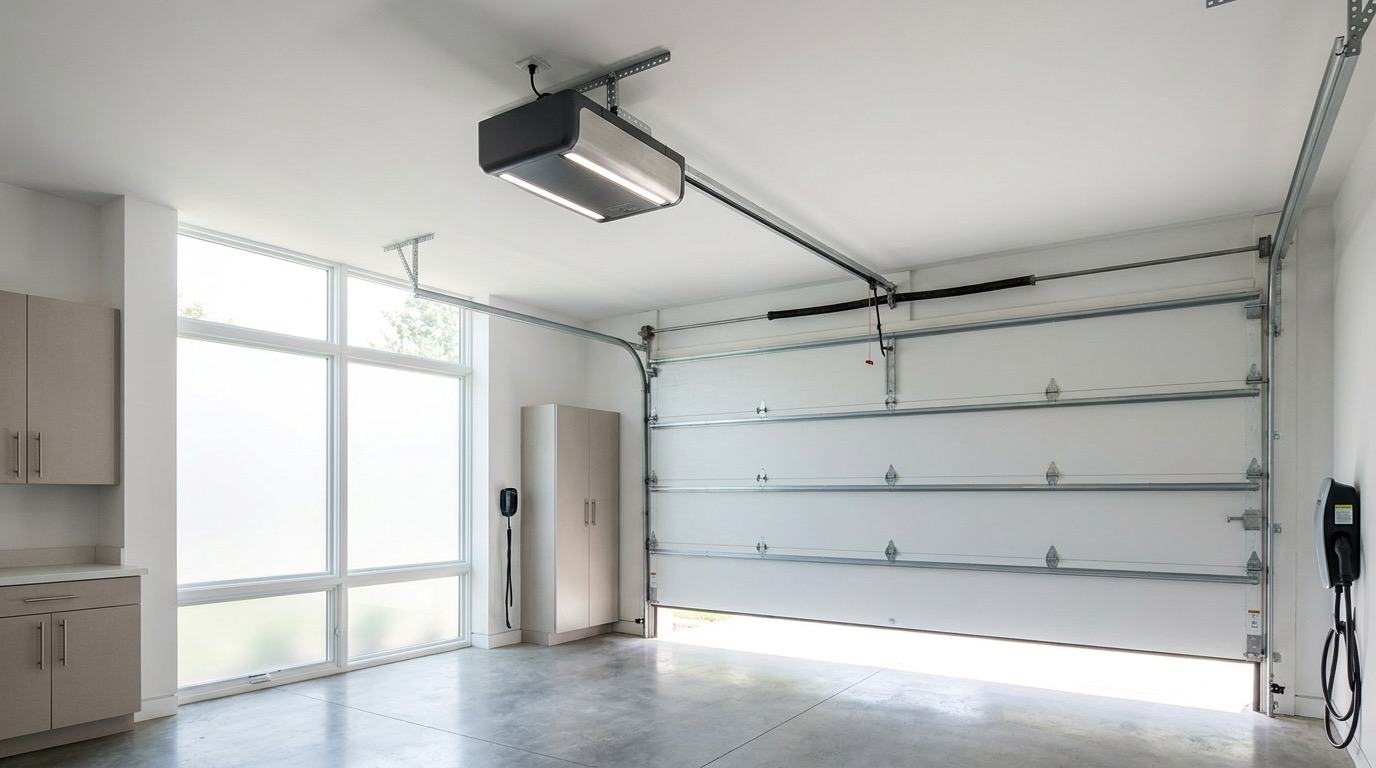
Instead of mounting on the ceiling rail, wall-mount openers mount beside the door on the wall and turn the torsion bar directly. They free up ceiling clearance (useful for high-lift doors, storage lofts, or low-clearance garages). LiftMaster’s 8500W is the market leader here.
Best for: garages with less than 3 inches of headroom above the door, spaces with ceiling storage or car lifts, and anyone who wants near-silent operation.
LiftMaster vs Chamberlain vs Genie: what’s actually different?
LiftMaster and Chamberlain: same parent, different channels
LiftMaster and Chamberlain are both owned by Chamberlain Group. They share hardware platforms, share the myQ app, and often share the same internal components. The differences are real but specific:
LiftMaster is sold through professional installers and wholesale distributors. The units are built to commercial-grade specs, carry longer warranties, and have features (P3 motor, Security+ 2.0 encryption, heavy-duty trolleys) that aren’t always in the retail versions.
Chamberlain is the retail line you’ll find at big-box stores. Entry-level Chamberlain units are solid for typical single-panel doors. Where Chamberlain starts to fall short is on heavy 2-car wood doors and high-cycle commercial applications.
The short version: if a pro is installing, you’re likely getting LiftMaster. If you’re buying at a home center, you’re getting Chamberlain. Both run myQ, both meet California battery backup requirements.
Top picks for 2026:
- LiftMaster 87504-267 (belt-drive, 1 HP, camera, battery backup): the current pro standard. $500–$650 installed.
- LiftMaster 8500W (wall-mount, 3/4 HP): best for high-clearance or storage-loft garages. $650–$850 installed.
- Chamberlain B2405 (belt-drive, 1-1/4 HP, battery backup): best retail value. $380–$520 installed.
- Chamberlain C2405 (chain-drive, 1-1/4 HP, battery backup): same as B2405 but chain. Around $180–$220 parts-only.
Genie: the independent option
Genie runs its own Aladdin Connect smart platform rather than myQ, which matters if you’ve already invested in Chamberlain’s ecosystem. Otherwise, Genie is a solid, independent choice with a strong dealer network and a domestic parts supply chain.
Top Genie picks for 2026:
- Genie 2562-TKV (belt-drive, 3/4 HP, battery backup): quiet, reliable, competitive with mid-tier Chamberlain. Around $200–$250 retail.
- Genie 4064-TKV (chain-drive, 3/4 HP, battery backup): dependable chain-drive entry point. Around $160–$190 retail.
Genie’s Aladdin Connect app is comparable to myQ for basic open/close monitoring and alerts. Where it falls short is third-party integrations: myQ has more official connections to home automation platforms.
Horsepower: don’t undersell your door
Most openers are marketed at 1/2 HP, 3/4 HP, 1 HP, or 1-1/4 HP. The number actually matters.
- 1/2 HP: Fine for a single-car lightweight steel door under 200 lbs. If this is the cheapest unit on the shelf, it’s sized for the lightest possible use case.
- 3/4 HP: The right starting point for most San Diego single-car homes with a standard steel door.
- 1 HP: Correct for most double-car steel doors (16x7 or 16x8), or any door over 300 lbs.
- 1-1/4 HP: Heavy wood carriage doors, oversized custom doors, or anyone who cycles the door 10+ times a day. If you have a heavy wood door in a Del Mar or La Jolla home, this is the right spec.
Under-sizing is the most common self-install mistake. A 1/2 HP opener on a heavy double door fails in 5–7 years instead of 12–15.
Smart features and myQ: what you actually get
Both LiftMaster and Chamberlain run on myQ: open/close remotely, get open/close alerts, set auto-close timers, share access with household members, and connect to Google Assistant, Alexa, and Apple HomeKit (HomeKit requires a separate $80 accessory). Genie’s Aladdin Connect offers similar core features but fewer third-party integrations.
For Wi-Fi setup steps and connection troubleshooting, our myQ smart garage control guide covers the full process. For professional smart garage door opener installation across San Diego, the pros in our network carry all major brands.
Battery backup: now required in California
SB 969 requires battery backup on all new opener installs in California. Every unit on this list qualifies. When the power goes out, the opener keeps running for 20–50 cycles, which matters during wildfire-related rolling outages in East County neighborhoods like Santee, Alpine, and Lakeside.
If your current opener predates 2020 and lacks backup, the Chamberlain CBU1 module ($50–$70) adds it as an accessory on compatible models. Confirm compatibility by model number before buying.
Noise and price: what to expect
Belt-drive runs 55–65 dB at 7 feet, chain-drive runs 70–80 dB. That gap is audible through a shared wall to a bedroom. If noise matters, belt-drive plus nylon door rollers (see the noise guide) is the combination. The cable and roller replacement is a common add-on when swapping an opener.
Price bands: what to budget in 2026
These are installed costs (equipment plus labor) from the pros in our network:
| Tier | Type | Installed cost |
|---|---|---|
| Entry | 1/2 HP chain-drive | $280–$380 |
| Mid | 3/4 HP belt-drive | $380–$520 |
| Premium | 1 HP belt-drive with camera | $500–$700 |
| Wall-mount | LiftMaster 8500W | $650–$900 |
Parts-only costs are roughly $120–$200 less. See the garage door opener installation cost guide for a full breakdown including permit considerations.
Recommendations by use case
- Single-car, attached garage: Chamberlain B2405 belt-drive, 3/4–1 HP. $380–$520 installed.
- Double-car or heavy wood door: LiftMaster 87504 or Chamberlain B6765, 1–1-1/4 HP. $500–$700 installed.
- Low-headroom or storage loft: LiftMaster 8500W wall-mount. $650–$900 installed.
- Detached garage, noise not a concern: Genie or Chamberlain chain-drive. $280–$420 installed.
- DIY retail install: Chamberlain B2405 is the most straightforward self-install. Verify your door’s weight before ordering.
For garage door opener installation and repair across San Diego, the pros in our network carry LiftMaster and can source Genie or Chamberlain on request.
Frequently asked questions
Is LiftMaster better than Chamberlain?
LiftMaster and Chamberlain share the same parent company and similar hardware. LiftMaster is the professional-install line with heavier-duty components and longer warranties. For a typical residential door, the difference matters most on heavy double doors or high-cycle applications. If a pro is installing, LiftMaster is usually the right call.
What’s the best garage door opener for a heavy wood door?
A heavy wood carriage door (typically 350–500 lbs on a double) needs at least 1 HP, and 1-1/4 HP is safer. LiftMaster’s 87504 or Chamberlain’s B6765 are the right-sized units. Under-sizing a heavy door is the single most common cause of premature opener failure.
Do I need a permit for a new opener in San Diego?
A straight swap-out typically doesn’t require a permit in most San Diego cities. Adding a new circuit or changing the door configuration usually does. The pros in our network handle the permit determination on every job.
How long does a garage door opener last?
Most residential openers last 12–15 years with normal use and basic maintenance. Chain-drive units at the low end, belt-drive and wall-mount at the high end. See the garage door opener lifespan guide for signs that yours is approaching end of life.
Ready to replace or upgrade your opener? Call Lift Pro SD at (858) 925-5546 for a same-day quote across all of San Diego County. The pros in our network serve Carlsbad, Encinitas, El Cajon, and every city in between. Most opener installs are done the same day you call.