
TL;DR
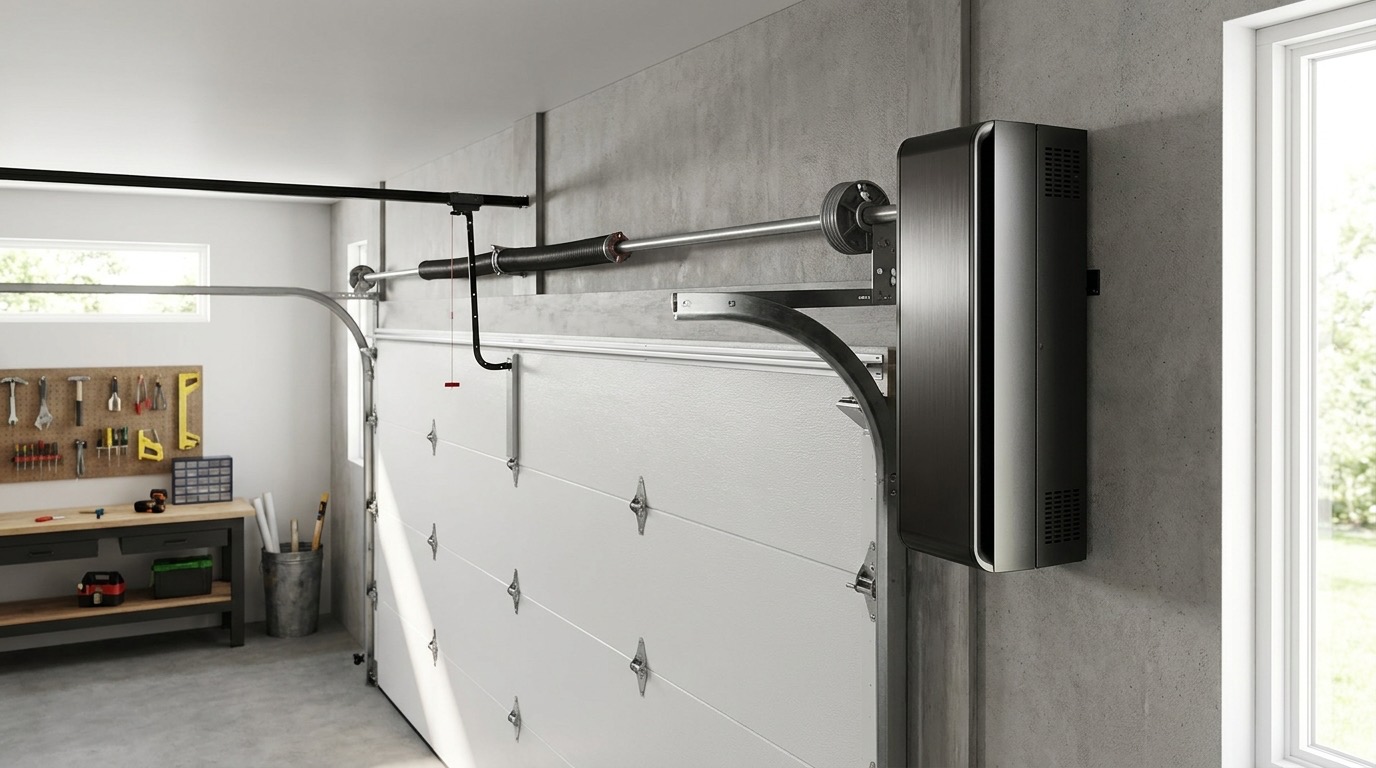
- A wall mount garage door opener (jackshaft style) mounts on the wall beside your torsion shaft instead of hanging from the ceiling, freeing every inch of overhead space.
- The LiftMaster 8500W is the dominant residential jackshaft unit. Expect $400–$650+ installed, compared to $250–$400 for a standard belt-drive.
- Jackshaft openers require a torsion spring door that is correctly balanced. Extension spring doors and improperly balanced doors are not compatible.
- Best-fit scenarios: ceilings over 9 feet, overhead storage systems, car lifts, and garages with a bedroom directly above.
- Call (858) 925-5546 to find out whether your door and garage qualify.
Most San Diego homeowners have only seen one kind of opener: the boxy motor hanging from a rail on the ceiling, pulling the door up by a chain or belt. It works. It’s what 85% of homes have. But it takes up ceiling real estate, limits storage, and it’s not your only option.
A wall mount garage door opener, also called a jackshaft opener, does the same job from the wall beside the door. If you’re building out a garage with storage overhead, adding a car lift, or dealing with a ceiling too high for a standard rail, this is the product to know about.
How a wall mount opener actually works
A standard overhead opener attaches to a horizontal rail along the center of the ceiling. It drives a chain, belt, or screw that connects to the trolley on the rail, which pulls or pushes the door via an arm.
A jackshaft opener does something entirely different. It mounts directly to the wall beside the torsion shaft, the steel tube that runs horizontally above your door and holds the torsion springs. The opener drives the torsion shaft directly using a gear-and-pulley mechanism. When the shaft turns, the springs wind or unwind and the door moves. No rail. No trolley. No ceiling footprint at all.
The motor sits roughly 18–24 inches off the floor beside the door jamb, usually at about shoulder height. It’s compact and out of the way.
The LiftMaster 8500 family
LiftMaster’s 8500W is the reference product in this category for residential use. It’s what the pros in our network install most often when a homeowner asks for a wall-mount unit. It includes a DC motor with soft-start and soft-stop, built-in myQ Wi-Fi, battery backup for power outages, and a timer-to-close function. The 8500W is the current version of the line (it replaced the older 3800 and earlier 8500). For professional garage door opener installation and repair, ask the tech which model fits your door weight and shaft length.
LiftMaster also makes the WLED, a jackshaft unit with integrated LED lighting worth considering if your garage has poor overhead light.
When a wall mount opener makes sense
You have high or cathedral ceilings
Standard rail-drive openers need clearance. The opener motor hangs below the ceiling, and the rail extends from the motor down to the header above the door. If you have a 10-foot, 12-foot, or cathedral ceiling, a rail-drive opener needs an extension kit, and even then you may not get the door to open fully.
A jackshaft opener has no rail, so ceiling height is irrelevant. This is the single most common reason San Diego homeowners in newer custom builds or converted spaces specify a jackshaft.
You want to use the ceiling for storage
Overhead storage racks are popular in San Diego garages because most homes don’t have basements or attics. A ceiling-mounted opener occupies the center lane of the garage, right where a storage system would go.
With a jackshaft opener, the full ceiling is available. Rack systems, surfboards, paddleboards, bikes: none of it has to route around a motor and rail.
You’re installing a car lift
A two-post or four-post car lift in a residential garage requires full overhead clearance. The vehicle goes up, and nothing can be in the way above it. A jackshaft opener is essentially required if you’re adding a lift to an existing garage.
Your garage is above or adjacent to a bedroom
Belt-drive openers are quieter than chain-drive. Jackshaft openers are quieter than belt-drive, because the motor is smaller and operates at lower RPM, and there’s no rail vibration transmitting into the ceiling joists. If someone sleeps directly above the garage, a jackshaft opener is the quietest residential option available.
Our smart garage door openers page covers the full range of quiet opener options if you’re comparing types.
What your door needs before a jackshaft opener will work
This is where many homeowners run into a surprise. Jackshaft openers are not compatible with every door.
Torsion springs only
A jackshaft opener drives the torsion shaft. If your door uses extension springs (the springs that run along the horizontal tracks above each side of the door), there is no torsion shaft to drive. The opener has nothing to attach to. You’d need to convert the door to a torsion spring system first, or choose a different opener type. See the torsion vs extension spring guide for a full breakdown of the difference.
Almost all residential doors in San Diego with a single spring above the door center already have a torsion setup. Doors with springs on the sides almost certainly have extension springs.
A properly balanced door
A jackshaft opener does not use a trolley and arm to physically carry the door. It winds and unwinds the springs. That means the springs do more of the real load-bearing work than on a rail-drive system. An improperly balanced door, one where the springs are worn or incorrectly tensioned, puts excess strain on the opener motor.
Before installation, a tech should check balance by disconnecting the opener and lifting the door to mid-height by hand. A balanced door holds position. One that drops fast or shoots up needs spring replacement before the jackshaft goes in.
Minimum clearance beside the jamb
The opener motor unit needs about 4 inches of clearance between the door jamb and the side wall to mount correctly. Most garages have enough space. Narrow garage openings or tight side-clearance situations may not.
Cost: what to expect in San Diego
Wall mount opener pricing has two components: the unit itself and the labor to install it.
Unit cost: The LiftMaster 8500W runs $280–$380 at the counter, depending on the supplier. Specialty lighting models like the WLED run higher.
Installation labor: $120–$250 depending on garage complexity, torsion spring condition, and whether additional wiring or a new outlet is needed. The opener requires a dedicated 120V outlet near the mounting location. Many garages only have an outlet near the center ceiling for the old opener, so running a new circuit is sometimes part of the job.
Total installed cost: $400–$650 for most San Diego homes. Complex installs, especially those requiring spring balancing or an electrical run, can reach $750–$900.
Compare that to a standard belt-drive opener installation: $250–$400 all-in for most homes. You’re paying a real premium for the jackshaft, but you’re getting ceiling clearance and meaningfully quieter operation in return.
For a full look at opener pricing by type, see garage door opener installation cost in San Diego.
Wall mount vs belt-drive: a direct comparison
| Factor | Belt-drive (ceiling) | Jackshaft (wall) |
|---|---|---|
| Installed cost | $250–$400 | $400–$650+ |
| Ceiling clearance needed | Yes | No |
| Storage overhead available | Limited | Full |
| Noise level | Moderate | Low |
| Extension spring compatible | Yes | No |
| Battery backup | Add-on | Built in |
| Wi-Fi | Optional | Built in |
| Lifespan | 12–15 years | 12–15 years |
Neither type is universally better. Belt-drive openers serve the vast majority of San Diego homes well. Jackshaft openers solve specific problems: high ceilings, overhead storage needs, car lifts, and bedroom-noise situations.
When a wall mount opener is not the right call
If your garage has a standard 8-foot ceiling, extension springs, and no plans for overhead storage or a car lift, a jackshaft opener adds cost without meaningful benefit. A belt-drive with a DC motor does everything a typical San Diego homeowner needs for less money. Jackshaft openers also require precise alignment at installation. Incorrect mounting causes uneven spring tension and accelerated wear. This is not a DIY project. See our opener installation and repair page for what a professional site assessment covers.
Frequently asked questions
Can I install a jackshaft opener on any garage door?
No. Your door needs a torsion spring system, not extension springs, and the torsion shaft must be the right diameter for the opener’s drive mechanism. The door also needs to be properly balanced. A tech should assess compatibility before you purchase the unit.
Is the LiftMaster 8500W worth the extra cost over a belt-drive?
It depends on your situation. If you have high ceilings, a storage rack system, or a bedroom above the garage, yes. If your garage is standard and storage isn’t a priority, a good belt-drive opener at $250–$350 installed does the same job for less money.
How loud is a jackshaft opener compared to a belt-drive?
Most installers describe jackshaft openers as about 20–30% quieter than a comparable belt-drive. Exact comparisons depend on door weight, spring condition, and roller quality. A door with worn metal rollers is loud regardless of which opener drives it. See why your garage door is noisy for the full breakdown on noise sources.
Does a jackshaft opener need its own electrical circuit?
Yes. The opener requires a dedicated 120V outlet near the mounting location on the wall beside the door. Many garages only have an outlet near the center ceiling for the old overhead unit. Running a new outlet adds $80–$150 to the install cost in most cases.
If you’re unsure whether a wall mount opener fits your garage, a quick assessment takes a tech about 15 minutes. The spring type, door balance, and side-clearance check are all visual. No teardown required.
Ready to find out if your garage qualifies? Call Lift Pro SD at (858) 925-5546. The pros in our network serve all of San Diego County, including Carlsbad, Encinitas, and La Jolla.